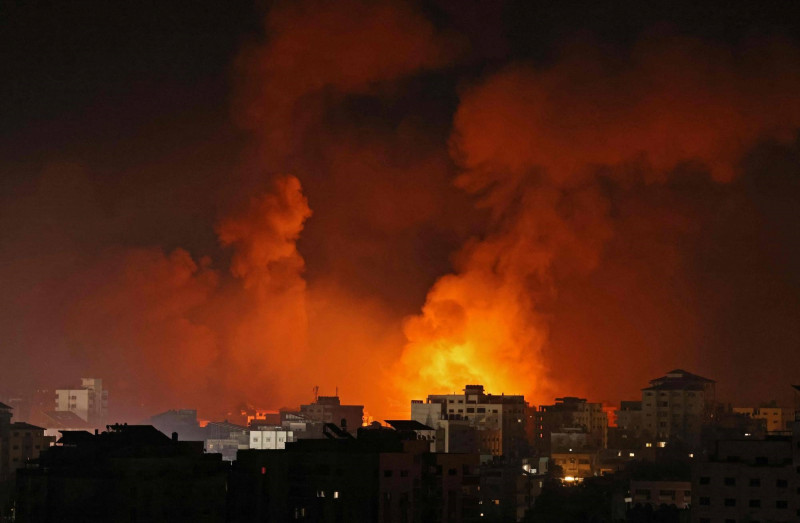
AMID relentless Israeli bombardments and expanding ground operations, Palestinians in Gaza City are paralysed by fear, trapped between the escalating destruction of their neighbourhoods and the near impossibility of fleeing to safety.
Israel has declared Gaza City a “combat zone” as part of its broader offensive to dismantle Hamas. Areas such as Zeitoun and Sabra have been heavily targeted, with entire blocks razed, according to satellite imagery. Residents have been ordered to evacuate so-called “red zones”, but for many, departure remains out of reach.
“The Israeli forces, when they mark any area by red colour and request people to leave, they really will destroy it,” AP reported Mohammed Alkurdi, a project manager currently sheltering in the city, saying today. “So it’s like you decide whether to live or die. It’s very simple like that.”
Since Friday’s declaration of the combat zone, only a fraction — approximately 14,840 of nearly one million residents — have fled Gaza City, mostly heading south, according to the Site Management Cluster, a humanitarian coordination body. Another 2,200 have been displaced within the city itself.
Alkurdi described the devastation as complete. “It’s not something partial like before. It’s 100%. The house, I’m telling my friends, it keeps dancing all the day. It keeps dancing, going right and left like an earthquake.” His family managed to leave Gaza last year. He remains alone and said he would leave only if his area comes under direct evacuation orders.
Zeitoun, once the city’s largest neighbourhood, filled with shops, schools and clinics, has been largely flattened. Satellite images from January, August and early September show entire districts reduced to sandy wastelands.
Amjad Shawa, director of the Palestinian NGO Network, left his home in the Rimal district at the start of the war but returned during the January ceasefire. He, too, is considering fleeing again. “Gaza will be levelled and destroyed. Last time, I had my car. There was fuel. Everyone had his income, his money,” he said. “Now, there is no Rafah. Almost no Khan Younis.”
For many, however, leaving is simply not an option.
“The elders, they’re saying we will die here,” Shawa said. “This has pushed the other members of the family to stay, not to leave.”
Norhan Almuzaini, a medical programme officer for Medical Aid for Palestinians, echoed this sentiment. “My aunt is elderly and can’t walk, and my mother also struggles with mobility. We have so many belongings and no way to manage them. It feels unthinkable.”
Amal Seyam, director of the Women’s Affairs Centre, has been displaced five times, twice to the south and three times within Gaza City. Now sheltering in the Nasr neighbourhood, she remains committed to her work.
“I will only leave when everyone who needs me here leaves. As long as there’s a woman who needs me, I am staying. All of Gaza feels like it’s in the red zone now anyway,” she said. “The bombing is happening metres from us, not kilometres.”
Her voice broke as she continued: “Many people have started packing. Many have already left. Do you know what displacement means? It means moving once again, building your life once again, buying new things, blankets, tents, all over again.”
Those who managed to flee to the south face a different kind of hardship. Tent camps are overcrowded, and food, water and sanitation are scarce. The arrival of displaced northerners has only deepened the crisis.
“The beach is crowded. Everywhere is crowded. There’s no hygiene. It’s a struggle to get water and food,” said Iman El-Naya, who left Gaza City three months ago.
Shorouk Abu Eid, a pregnant woman now in Khan Younis, said basic mobility is now a daily ordeal. “There is no privacy, no peace of mind. Places I used to walk to in five or 10 minutes are taking me around an hour now because of the congestion. There’s barely 10 centimetres between tents.”
Jamal Abu Reily, another displaced resident, said conditions have reached breaking point. “The bathrooms are overflowing and there’s so little room for new arrivals. How are we going to all fit here? Where are they going to stay? In the sea?” - Sept 4, 2025