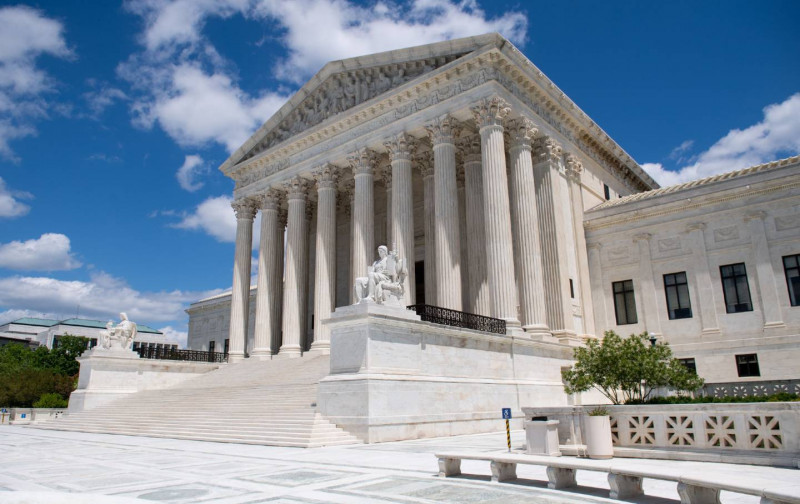
THE US Supreme Court has once again sided with President Donald Trump, granting a temporary freeze on approximately US$4 billion in congressionally approved foreign aid, as the administration pursues its “America First” policy by halting funds deemed contrary to its foreign policy priorities.
Reuters reported on Saturday that the ruling, issued in an unsigned order, effectively blocks a lower court’s directive for the administration to release the funds.
The decision came in response to a lawsuit filed by a coalition of aid organisations after the White House moved to withhold money earmarked by Congress for global humanitarian initiatives, including UN peacekeeping and international democracy-promotion efforts.
The justices’ order suggested that the aid groups may lack the legal standing to challenge the administration’s decision, and expressed concern that ruling against the president at this juncture could undermine his constitutional authority over foreign affairs.
The court’s three liberal justices dissented. Writing for the minority, Justice Elena Kagan called the decision “an affront to the constitutional principle that power is separated between the three branches of government.”
“The Constitution gives Congress the power to make spending decisions through the enactment of appropriations laws,” Kagan wrote in a dissent joined by Justices Sonia Sotomayor and Ketanji Brown Jackson. “If those laws require obligation of the money, and if Congress has not by rescission or other action relieved the Executive of that duty, then the Executive must comply.”
The Trump administration has argued that the US$4 billion in question — part of a broader US$11 billion allocation set to expire at the end of the fiscal year on 30 September — should be rescinded because it does not align with current US foreign policy. The funds were targeted through a rarely used manoeuvre known as a “pocket rescission,” designed to run out the clock on spending before the fiscal year’s end.
US District Judge Amir Ali had ruled on 3 September that the administration’s action violated the Constitution’s separation of powers and ordered the funds to be disbursed. The decision was upheld by the Court of Appeals for the District of Columbia Circuit in a 2-1 ruling, prompting the government’s emergency appeal to the Supreme Court.
Nick Sansone, legal counsel for several aid organisations involved in the case, said the court’s decision “further erodes separation of powers principles that are fundamental to our constitutional order” and “will also have a grave humanitarian impact on vulnerable communities throughout the world.”
In court submissions, the Department of Justice claimed that Ali’s injunction posed “a grave and urgent threat to the separation of powers,” arguing that it would be “self-defeating and senseless for the executive branch to obligate the very funds that it is asking Congress to rescind.”
This marks yet another instance in which the Supreme Court, which holds a 6–3 conservative majority, has sided with the Trump administration since his return to office in January. Earlier this year, the court allowed the president to withhold US$2 billion in previously contracted aid payments in a similar case.
The White House’s strategy, led by budget director Russell Vought, hinges on the argument that the president may delay spending for up to 45 days after formally requesting a rescission — a move critics say effectively circumvents congressional authority. The White House has admitted the tactic was last employed in 1977, under vastly different circumstances.
Legal scholars have noted that this attempt to claw back billions in appropriated funds has no clear precedent in US history, further stoking constitutional concerns as the end of the fiscal year looms. - September 27, 2025