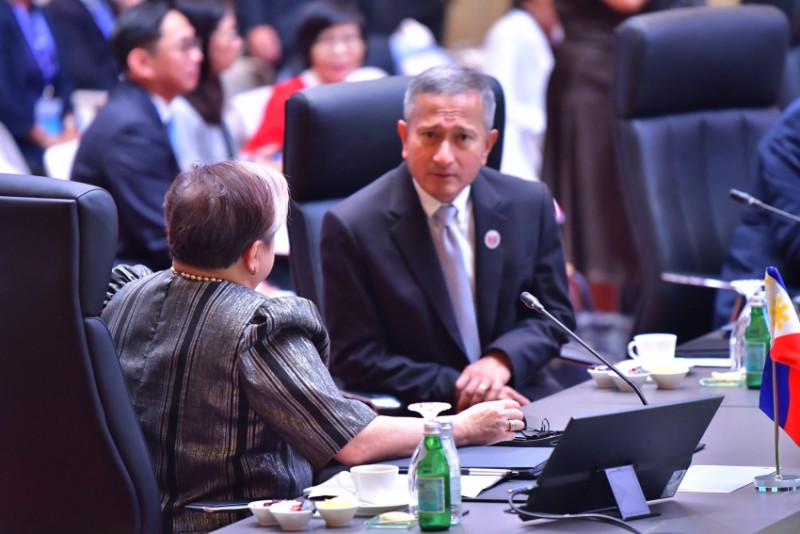
SINGAPORE’S Foreign Minister Dr Vivian Balakrishnan has warned that a diminished United Nations would be profoundly damaging for small states, which rely on the world body as the only inclusive forum for international dialogue and cooperation.
Speaking to Singapore media at the conclusion of the 2025 United Nations General Assembly (UNGA), Dr Balakrishnan described the UN as “still the only game in town”, stressing that even amid global divisions, it remains a critical space where “everyone is present”.
“If there’s sufficient goodwill and maturity, in fact, some very good conversations can be had, even on very difficult issues,” he told The Straits Times today. “So, I would say there is a risk of fracture, but the UN is still the only game in town, and it’s our duty to lean in and help this process of engagement.”
He noted that while concerns are growing about the UN’s effectiveness—particularly the increasing use of veto powers by the five permanent members (P5) of the Security Council—there have also been tangible signs of progress, many involving active contributions from smaller nations.
Among them, Singapore’s Ambassador Rena Lee presided over negotiations for the High Seas Treaty, which will enter into force in January 2026; Ambassador Burhan Gafoor chaired the UN’s cyber-security working group that achieved consensus across rival powers; and Daren Tang, Director-General of the World Intellectual Property Organization, concluded two new treaties under his leadership.
“These are significant achievements,” said Dr Balakrishnan. “Small states like Singapore, or even medium powers, still have agency, still have strategic options, and the need for us to lean in, to support one another, and to keep multilateral processes and that mindset alive and well.”
He identified three core clusters dominating this year’s UNGA: conflict and peace, economic development and sustainability, and the global commons—including climate change, pandemics, and emerging technologies like artificial intelligence.
Dr Balakrishnan also addressed the geopolitical currents shaping today’s global order, noting that the post-World War II era—marked by rules-based cooperation and unprecedented prosperity for small nations—is rapidly giving way to a more fragmented and competitive international landscape.
“The old world order is over,” he said bluntly. “The United States, which underwrote that order, now feels that others have free-ridden without compensating it. Meanwhile, China’s rise since 1978 has changed the global balance of power.”
He added that the intensifying superpower rivalry has made it more difficult to forge consensus within the UN and to respond effectively to transboundary challenges.
“There is anxiety about the UN’s effectiveness. The Security Council still reflects the realities of 1945, even though power, technology and influence are now much more widely distributed,” he said.
Against this backdrop, Dr Balakrishnan reiterated that for small states like Singapore, the UN is not a luxury but a necessity—one that must be preserved through active participation, principled diplomacy, and meaningful reform. - September 28, 2025