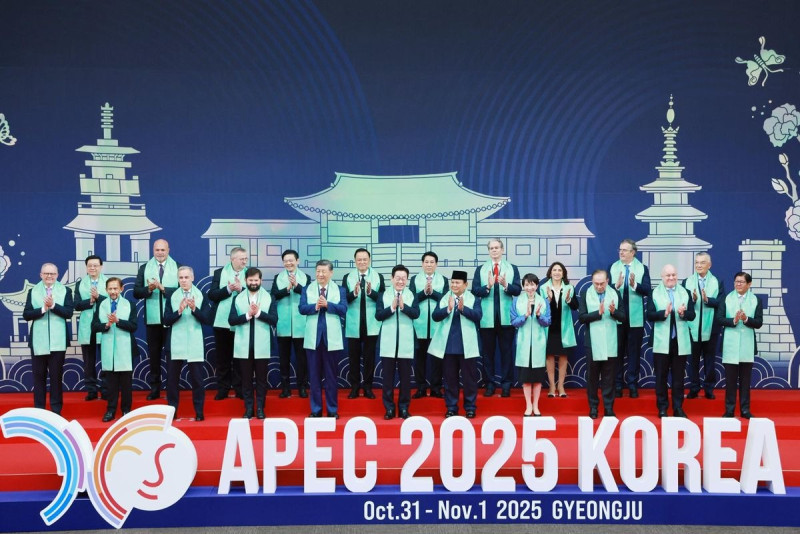
LEADERS of the 21 Asia-Pacific Economic Cooperation (APEC) member states adopted the “Gyeongju Declaration” on Saturday, marking the conclusion of the 2025 APEC Economic Leaders’ Meeting in Gyeongju.
The summit also saw South Korean President Lee Jae Myung formally hand over the APEC chairmanship to Chinese President Xi Jinping.
“With APEC’s support and cooperation, the realization of peace and coexistence on the Korean Peninsula will be possible,” President Lee said, urging continued interest and engagement from participating nations.
In his closing remarks, President Xi announced that next year’s summit will be held in November in Shenzhen, China. “China, as next year’s chair, will work for the prosperity of the Asia-Pacific region,” he said.
Earlier, President Lee chaired the summit’s second session, known as the Retreat, focused on “Preparing a Future-Ready Asia-Pacific.”
The session addressed regional challenges including the rapid advancement of artificial intelligence (AI) and demographic shifts resulting from low birthrates and aging populations.
Lee highlighted the region’s AI capabilities, noting that five of the world’s top 10 countries in AI are APEC members and that all leading nations with the highest number of AI-related patents belong to the forum. “The key principle is to build an AI-based society that drives inclusive growth — AI for all,” he said.
On demographic challenges, Lee said: “Demographic changes pose a serious and far-reaching challenge that affects the economy, labor market, and education and welfare systems — a problem too complex to be addressed by individual efforts alone.”
He proposed a Joint Framework on Responding to Demographic Change to foster collective solutions within APEC.
President Lee concluded by expressing hope that member economies “will collaborate through innovative ideas — from fostering inclusive growth that embraces future generations to developing AI-based strategies to address population challenges.”- November 1, 2025