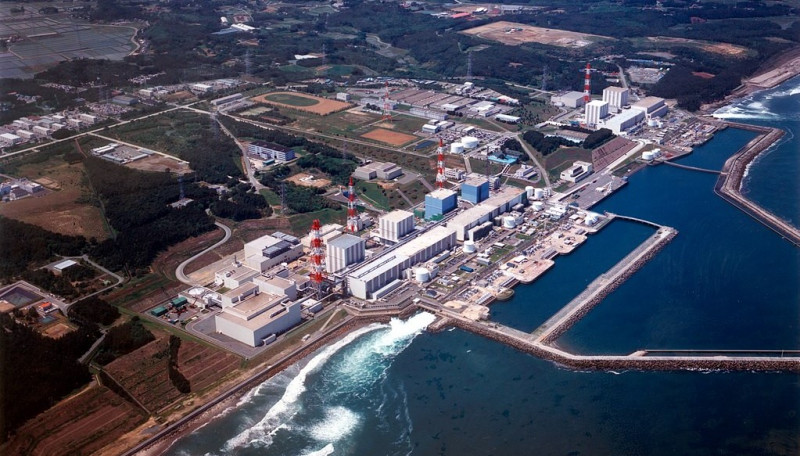
AUCKLAND – Japan is set to discharge millions of tonnes of treated wastewater from the Fukushima nuclear reactor, which was damaged in the 2011 Tohoku earthquake and tsunami, into the Pacific Ocean.
The impending release of treated radioactive water has divided opinion.
Japan’s aquaculture industry, along with environmentalists and neighbouring countries such as China, Korea and Pacific Island nations, have all expressed concern about the plan.
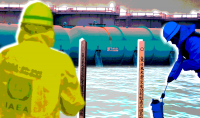
The Japanese government is working with the International Atomic Energy Agency (IAEA), which regulates safety standards. They assert that the treated water is safe to release and have backed Japan’s plans.
Physicist Jamie Quinton, a professor and head of the School of Natural Sciences at Massey University in New Zealand, answers seven key questions about the plan.
What is happening with the Fukushima nuclear reactor?
In August 2013, a Fukushima operator revealed that up to 300,000 litres of untreated wastewater – water needed to keep the exposed core in each of its three damaged reactors cool – from the Fukushima nuclear reactor had leaked from a storage tank, and may have been doing so since the tsunami in March 2011.
Although Tokyo Electric Power (Tepco) claimed this leaked water had seeped into the ground and not flowed into the ocean, the plant is located right on the shoreline, and contamination has most likely occurred. This untreated water contained over 100 times the legal limit for radioactivity release.
Tepco subsequently built infrastructure to extract tonnes of newly contaminated water each day, including a processing plant called the ALPS (Advanced Liquid Processing System), designed to filter the heavy radioactive elements present in the wastewater.
While ALPS dramatically improved the elemental profile of the wastewater, the leaks resulted in public mistrust of Tepco through water being released from the Fukushima plant.
For several years, Japan has been intending to release over 1.25 million tonnes of treated Fukushima wastewater into the sea as part of its plan to decommission the power station when its storage capacity reaches its limit in 2023.
In part, this is to mitigate risks posed by keeping the water in the storage tanks and avoid a situation where the wastewater is released in an uncontrolled manner for any reason, such as an earthquake or other natural disaster.
The Japanese say the water is now safe to be released. Is it?
Yes, according to the IAEA. The IAEA has strict guidelines and international standards on acceptable practices for radiation protection and oversees the release of water used in fission reactors around the world, and it has endorsed Tepco and the Japanese government’s proposal to release the treated water.
However, some experts and many Pacific Island leaders have concerns.
In March 2022, an independent panel of global experts on nuclear issues supported Pacific nations in their consultations with Japan over its intentions to discharge treated nuclear wastewater into the Pacific Ocean.
Tepco claimed for years that ALPS removed all radioactive materials except for tritium, but in 2018 admitted it was not perfect and did not completely remove all of the harmful heavy radioactive elements.
This has led to further mistrust, and people quite logically come to the ecologically responsible conclusion that “dilution is not the solution – no release means no increase in radioactivity in the ecosystem”, and that Tepco would need to process the water multiple times to remove as much of the heavier radioactive species as possible.
So, how radioactive is the water?
Of the radioactive elements present in the wastewater, the primary component is tritium. The ALPS can filter heavy elements well but is very poor at filtering lighter elements from the wastewater.
Tritium and deuterium are an isotope of the lightest element – hydrogen. Tritium and deuterium also have an atomic number, Z, of 1, as they all have only one proton in the nucleus (this is why hydrogen is the first element on the periodic table). Hydrogen has only the proton and no neutrons; deuterium (D) has one proton and one neutron; and Tritium (T) has one proton and two neutrons.
These heavier isotopes of hydrogen are created by neutrons, which are plentiful because nuclear fission reactors run on neutrons.
For these isotopes of hydrogen, with the addition of each extra neutron, there is an increase in radioactivity.
A radioactive nucleus emits radiation to become more stable. The radioactivity of a given object, or volume of water, is measured in Becquerels, with 1Bq meaning one radioactive decay event (i.e. an atom alters its nuclear state and emits one photon of ionising radiation) per second.
Hydrogen has the most stable nucleus of these isotopes. Deuterium and tritium are radioactive, but chemically they are equivalent to hydrogen, so when present in the water, there are molecules of H2O, D2O, T2O, DOH, TOH, and DOT.
The natural abundance of these isotopes wherever we find hydrogen, including in water, is that hydrogen occupies 99.9%, deuterium 0.02% and tritium is present in extremely low amounts (1 tritium in 1,000,000,000,000,000,000 atoms of hydrogen).
Fukushima wastewater will have a significantly greater concentration of tritium than naturally found in water but still only accounts for a small amount overall.
Based on radioactivity measurements reported, there is approximately 2.4g of tritium within the 1.25 million tonnes of wastewater.
Is tritium dangerous?
Tritium, when present in water, is of low risk to humans.
The main concern for humans occurs when tritium is ingested into the body through breathing it into our lungs or eating food that contains it in high concentrations.
This is why Chernobyl was considered 10 times more hazardous than Fukushima. At Chernobyl, the water became airborne as steam when the accident occurred. The biological half-life (the average time for a human to pass half of a contaminant substance out of their body) of tritium is estimated to be seven to 10 days.
The type of radiation emitted and the energy it carries are the most important parameters determining the cancer risk to humans.
For tritium, beta radiation is emitted, carrying a maximum energy of 18 keV, which is relatively small. (To give an idea of what these energies mean, when you get a diagnostic X-ray of a part of your body, low-energy X-rays of around 1 keV are used. In radiotherapy, where the intention is to kill cancer cells, X-rays or gamma rays with around 1000 times more energy i.e. 1 MeV or 1000 keV are typically used).
In air, an electron with 18 keV of energy travels about 10cm on average before losing its energy, but in water, it is only a few micrometres – less than the diameter of one strand of hair.
Tritium has a half-life – the time it takes to lose half of its radioactivity (the shorter the half-life, the more radioactivity) – of 12.35 years.
But the half-life is only part of the story. It tells you how frequently atoms of a particular element and isotope emit radiation to become more stable. This is much longer than the biological half-life, which also makes it low-risk.
Over a 30-year period, 81.5% of the total tritium will have radioactively decayed.
How much tritium is in the water?
The concentration of tritium in the wastewater is around 10 million times more prevalent than that found naturally in water. However, tritium is still around 10 parts per trillion, meaning there is one tritium atom for every 100 billion hydrogen atoms.
By releasing into the ocean, the tritium concentration will be extremely diluted (the tritium will quickly become trace concentrations of many orders of magnitude less when released into the sea).
Is there anything else in the untreated water that is harmful?
There are several radioactive isotopes of concern – iodine-131, caesium-137, strontium-90 and cobalt-60 – all of which are produced during the various decay pathways of the uranium fuel in the nuclear reactor core.
These are the radioactive elements of note that are capable of damaging human cells and are claimed to be removed from the wastewater by the ALPS processing plant.
Both iodine-131 and caesium-137 are used in nuclear medicine radiotherapy applications, which means they have sufficient energy to cause cell death and mutation. In other words, they are capable of producing cancer.
If ingested, strontium-90 becomes biomineralised like calcium and deposits in teeth and bones, which means it remains in the body until after it has emitted its radiation.
Cobalt-60 is created by neutron activation of iron and nickel structures within the reactor but of the radioactive elements listed here, Cobalt-60 is the most undesirable and potentially most harmful as it decays via three energetic emissions in the form of two gammas and one beta.
All these radioactive species are hazardous to life and must be eliminated from being released into ecosystems.
As organisms consume other organisms throughout the food chain, they can eventually be consumed by humans, who will absorb the accumulated radioactivity. These radioactive species must be kept out of natural ecosystems as much as possible, especially the ocean.
So, should we be worried?
The panel of global experts and the IAEA should establish monitoring of radiation levels prior to, during and after any release of wastewater into the ocean.
Hopefully, the Japanese government and Tepco have explored the possibility of seeking alternative uses for the tritiated water through chemical suppliers and the global nuclear fusion community, as tritium is a key fuel of interest for nuclear fusion research.
If the release of wastewater into the ocean is to proceed, getting the process correct and within regulations is vital to Japan’s aquaculture-based industries.
It is in Japan’s economic interest to ensure that the waterways remain below the internationally acceptable levels for background radiation so that food safety is assured and their capacity for international trade remains unaffected. – The Vibes, April 15, 2023
Jamie S. Quinton is the professor and head of the School of Natural Sciences at Massey University in Aotearoa, New Zealand. Prior to joining Massey, he was a professor of physics and nanotechnology and dean of science at Flinders University. He has published over 150 peer-reviewed research articles. He was the Flinders University winner of the student-nominated Unijobs Lecturer of the Year Award in 2009. He was awarded a prestigious Citation for Outstanding Contribution to Student Learning by the Australian Learning and Teaching Council in 2010.
Published under Creative Commons and in partnership with 360info.org