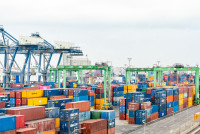
KUALA LUMPUR – Malaysia’s gross domestic product (GDP) is expected to turn around to record a growth of 11%-13% in the second quarter (Q2) of 2021, from the negative growth trajectory for the past four quarters thanks to higher industrial production and exports, said Ambank Research.
This is based on Q2 2021 performance, which saw industrial production averaging at 25.9% year-on-year (y-o-y) compared to 4.0% in Q1, and exports at 44.0% y-o-y against 18.0% y-o-y in Q1, as well as the low base.
The research house has maintained Malaysia’s 2021 economic growth at between 4.0% and 4.5%.
“The outlook for the second half of 2021 will depend on the vaccination speed, management of Covid-19 cases, reopening of the economy, stimulus measures, and domestic stability,” it said in a note today.
Ambank Research said the labour market recovery may hit another bump in July due to the extension of Covid-19 restrictions, pushing the unemployment rate further from the pre-pandemic level.
“Still, we maintain our unemployment rate expectations for the full year at 4.5%, underpinned by the encouraging vaccination rate, easing restrictions and reverberations of the government’s fiscal stimulus,” it added.
June’s unemployment rate rose to 4.8% from 4.5%, which is the lowest point since March 2020. It was the first increase after four consecutive months of decline since January 2021.
“It is also worth noting that due to the implementation of the latest lockdown, the number of persons who were temporarily not working soared to 801,000 persons from 139,600 in May,” it said.
Meanwhile, CGS-CIMB Securities said Covid-19 remained the key source of uncertainty for the economic outlook, marked by fears over a shrinking fiscal space and policy options should GDP growth fall short of its forecasts of 3.9% in 2021 and 4.7% next year.
The brokerage firm said investors were keen to understand where government resources would be directed for the nation’s recovery and sources of financing.
“Expectedly, our non-consensus forecast of three overnight policy rate hikes in 2022 was met with some resistance as clients fretted over the persistence of the Delta variant wave, potential economic scarring and tentative recovery prospects, limited fiscal space, as well as developing political instability.
“However, they were receptive to our view that Bank Negara Malaysia falling behind the curve in recalibrating monetary policy, especially if inflationary pressures emerge, and the US Federal Reserve proceeds with policy normalisation could weaken the ringgit,” CGS-CIMB Securities said in a statement.
It noted that announcements in recent days of a gradual reopening and relaxation of restrictions for fully vaccinated individuals signal an inflection point towards economic recovery, barring a potential deterioration of the Covid-19 situation. – Bernama, August 11, 2021