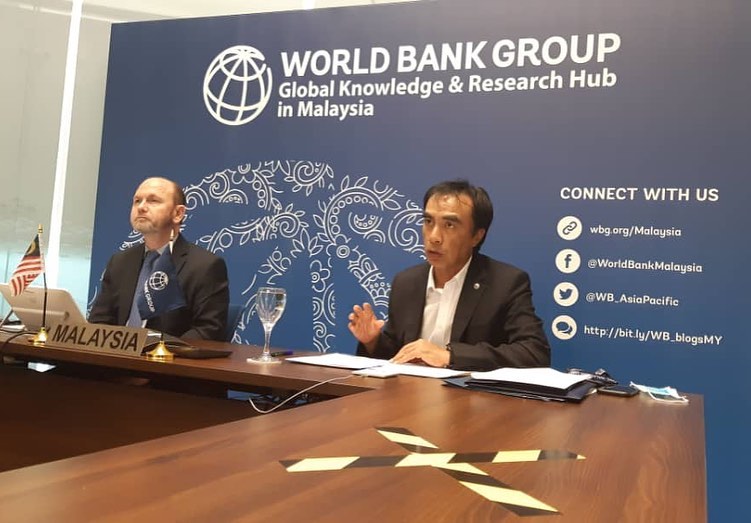
KUALA LUMPUR – Malaysia critically needs trade-based solutions to ease liquidity constraints brought by the Covid-19 pandemic, said Bank Negara Malaysia assistant governor Adnan Zaylani Mohamad Zahid.
He said the pandemic, which led to subdued domestic demand and stringent containment measures, had resulted in a liquidity squeeze among Malaysian businesses, particularly the small and medium enterprises (SMEs).
“To stay afloat, some companies have had to resort to increased debt to meet their payment obligations,” he said at the launch of the World Bank’s Islamic Trade Finance Report today.
While measures have been introduced to lessen the burden of SMEs in the form of wage assistance programmes, support grants and deferment of financing instalments, Adnan Zaylani said these are merely temporary stopgap measures, and prolonged assistance in this form may not be sustainable.
He also noted that overdependence on debt-based instruments have also reduced the financial flexibility of businesses in supporting recovery.
According to him, trade-based solutions can offer a viable option where funding is tailored to the life cycle of production, allowing companies to obtain short-term liquidity via the sale of current assets such as receivables and inventories to financial institutions without increasing their debt.
However, the structuring of such solutions entails new sets of risks to financial institutions, said Adnan Zaylani.
“In contrast to debt financing, the financier is exposed to risks beyond credit, such as inventory and market risk, which call for additional safeguards for risk mitigation and different approaches to risk management, infrastructure and practices.
“Given the nature of the exposure, this warrants Islamic financial institutions (IFIs) to adopt an exploratory approach to new trade-based offerings. This allows for a better understanding of the risks and their dynamics, thus enabling IFIs to put in place the appropriate framework and policies,” he added.
Another important thrust for the central bank and, in particular, Islamic finance, said Adnan Zaylani, is to help businesses embrace sustainability and build resilience to climate change where the urgent need for an inclusive and greener recovery is undeniable.
He said as a trading nation, Malaysia could lose US$65.3 billion (RM276.19 billion) worth of annual export revenue if the country does not embrace the transition towards a low-carbon, climate-resilient economy by 2025.
He pointed out that trade partners have started to impose expectations on sustainability as preconditions to transact.
For example, Adnan Zaylani noted, Malaysia’s major trade partners such as China and the European Union (EU) have committed to net zero emissions by mid-century and the EU’s recently proposed Carbon Border Adjustment Mechanism will increase the cost of business to export to these markets.
“It is clear that sustainability is no longer a ‘nice-to-have’ but an imperative business consideration critical for long-term survival.
“It is encouraging to see that the financial sector is stepping up on this front, including via the offering of sustainable finance solutions and assistance to companies in their transition journey. IFIs have led and continue to lead through value-based intermediation practices,” he added. – Bernama, August 23, 2021