Business

Kenanga expects BNM to continue monetary tightening bias

Meanwhile, investment firm predicts ringgit’s strengthening against greenback by year-end

Updated 3 years ago · Published on 08 Sep 2022 11:53AM

Kenanga expects BNM to continue monetary tightening bias
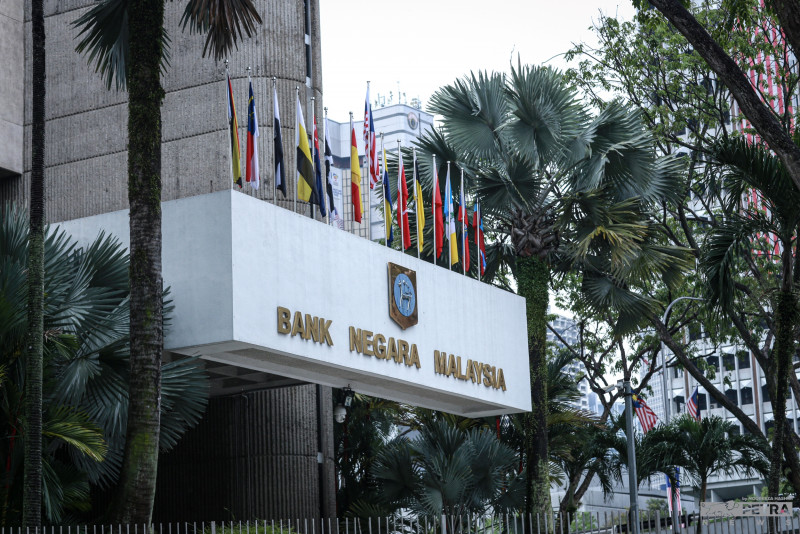
Yesterday, Bank Negara Malaysia announced that the international reserves fell by US$1.0 billion or 0.9% month-on-month to US$108.2 billion as of Aug 30, 2022 – its lowest level since December 2020, mainly due to the sharp drop in foreign currency reserves. – The Vibes file pic, September 8, 2022

KUALA LUMPUR – Bank Negara Malaysia (BNM) is likely to continue its monetary tightening bias until at least the first quarter of 2023, supported by the improvement in the Malaysian labour market and the country’s robust economic recovery, said Kenanga Investment Bank Bhd (Kenanga).

In a research note today, it said improved domestic labour market and economic recovery may compel BNM to raise the overnight policy rate (OPR) by another 25 basis points (bps) during its Monetary Policy Committee meeting today in an effort to preempt the build-up of demand-side inflationary pressure.

“Moving forward, we expect BNM may continue to raise the OPR in 25 bps increments at every meeting until January 2023, bringing it to 3.00%,” it added.

Meanwhile, Kenanga forecast the ringgit to be traded at 4.35 against the dollar by year-end, compared to 4.17 at the end-2021.

“The ringgit still has the potential to reverse its losses and strengthen to around the 4.35-level by end-2022 amid favourable domestic economic prospects, potential US dollar seasonal weakness and elevated commodity prices,” it said.

It added that the local unit is also expected to benefit from a potential rebound in the Chinese yuan post-Chinese Communist Party’s Congress in October.

“However, our forecast is subject to significant downside risks, including domestic political uncertainty, a possible invasion of Taiwan by China, and bets of another super-sized United States Federal Reserves rate hike post-Federal Open Market Committee meeting this month,” Kenanga said.

Yesterday, BNM announced that the international reserves fell by US$1.0 billion or 0.9% month-on-month to US$108.2 billion as of August 30, 2022 – its lowest level since December 2020, mainly due to the sharp drop in foreign currency reserves.

The central bank said the amount is sufficient to finance 5.4 months of imports of goods and services (previously retained imports) and is 1.1 times total short-term external debt. – Bernama, September 8, 2022

Related News

Malaysia / 1y

Economy grew 5.9% in Q2, says Bank Negara

Business / 2y

Zero-cost transactions via DuitNow QR to stay for small businesses: BNM

Malaysia / 2y

Bank Negara to set up special anti-fraud website

Business / 2y

Bank Negara names Adnan Zaylani as deputy governor

Business / 2y

BNM, banks, agencies commit to fight rising online fraud

Malaysia / 2y

250,000 suspicious transaction reports received in 2022: BNM deputy governor

Spotlight

Malaysia

Grandfather charged with raping 12-year-old granddaughter

Malaysia

MACC application to stop Na'imah managing assets in Jersey to be heard on August 13

Malaysia

AI-powered probe uncovers SOCSO fraud syndicate exploiting disabled, identity thefts

Malaysia

Salesman pleads guilty to slashing motorcyclist, causing severe injuries

Malaysia

AirAsia warns job seekers of fake recruitment website stealing personal data, demanding fees

Malaysia

Malaysia Stadium Corporation CEO charged over alleged RM1m bribery solicitation

Malaysia

Johor MB to defend state seat in upcoming polls

By Alfian Z.M. Tahir

You may be interested

Business

KPJ posts strong FY2025 performance, sets sights on next growth phase

By Alfian Z.M. Tahir

Business

Brent crude plummets below US$80 as US-Iran peace deal hopes eclipse Wall Street AI slump

Business

Oil prices slide as US-Iran peace deal raising hopes of supply recovery

Business

US dollar surges to three-month high as Fed signals possible rate hike

Business

US dollar weakens as markets await Warsh's first Fed decision