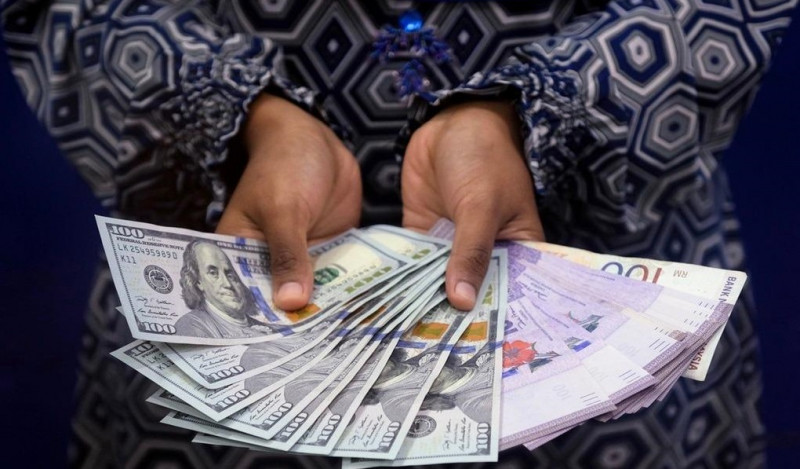
KUALA LUMPUR – The ringgit is expected to see further declines next week against the greenback at around the 4.50-4.60 levels on a lack of catalysts and ahead of the US central bank decision on interest rates, said an analyst.
Amid rising inflation worries, including in emerging market (EM) economies, investors are holding off on their buying interest in EM assets and would remain focused on safe-haven assets such as the US dollar, she said.
The expectation of another increase in the interest rate by the US Federal Reserve in the Federal Open Market Committee meeting next week is also weighing on the ringgit.
“The ringgit needs a fresh boost to attract buying interest from investors. But now, we think investors may take a wait-and-see approach for the ringgit, until Budget 2023 is announced, which is scheduled to be tabled on October 7.
“(However) Malaysia’s economy is still doing well, given that fundamentals are strong and debt levels are manageable,” she said.
During the week, Finance Minister Datuk Seri Tengku Zafrul Tengku Abdul Aziz said in a social media post that Malaysia is not experiencing an economic crisis just because the ringgit is trading at a low level against the US dollar.
He explained that the ringgit’s performance should be viewed holistically, not just in comparison with the US dollar, as the local note has strengthened against other currencies.
Tengku Zafrul also stressed that the International Monetary Fund never stated that Malaysia has economic problems that would cause the country to go bankrupt, and instead is confident of the country’s growth prospects.
Meanwhile, the ringgit hit another new low on Thursday since the Asian financial crisis, trading at 4.5340/5365 against the US dollar compared with 4.4965/4990 at last Friday’s closing.
For the shortened trading week, the local currency also traded mostly higher against a basket of major currencies.
It appreciated against the British pound to 5.2214/2242 from 5.2249/2278 and improved against the euro to 4.5317/5342 from 4.5361/5386 this week.
The ringgit rose against the Japanese yen to 3.1647/1666 from 3.1670/1690 but eased against the Singapore dollar at 3.2238/2261 from 3.2189/2209 a week earlier.
Markets were closed yesterday for the Malaysia Day celebration.
Bursa Malaysia is expected to trade sideways next week, with the benchmark FTSE Bursa Malaysia KLCI (FBM KLCI) to move between the 1,460 to 1,480 level amid the uncertain regional performance, an analyst said.
Rakuten Trade Sdn Bhd vice-president of equity research Thong Pak Leng said technically, the FBM KLCI should see immediate support at 1,460 while resistance at 1,500.
He said the short-term FBM KLCI market sentiment is reckoned to remain jittery as investors remained cautious due to persisting worries about inflation and the tighter policy stance of global central banks.
“We advise investors to stay alert for bargain hunting opportunities,” he said.
UOB Kay Hian Wealth Advisors Sdn Bhd head of wealth research and adviser Mohd Sedek Jantan said the short trading week started positively following a positive performance on wall street last week coupled with an unexpected moderation in Chinese inflation data to 2.5% in August from 2.7% previously and an easing in European natural gas prices.
“FBM KLCI started the week slightly higher with energy and banking stocks leading the gainer,” he said.
However, he said the bourse’s momentum was getting slower on Tuesday due to profit-taking, despite the positive performance in the US market, and investors awaiting the US inflation report for August.
“As the US consumer price index report came in 0.1% higher over last month, and 8.3% year-over-year versus expectations of 8.1%, it has pushed a sizable sell-off.
“The negative sentiment spiked market volatility and pushed FBM KLCI to close lower with the regional market,” he said.
As such, he said a slower recovery in FBM KLCI is expected next week, pending the Fed’s decision.
Sedek said investors are also waiting for the development from the meeting between Chinese President Xi Jinping and Russia’s Vladimir Putin later today.
“As the Malaysian market closed for Malaysia Day, any surprise data might have less impact. Overall, the market will remain cautious for next week,” he said.
Bursa Malaysia and its subsidiaries will resume operations on Monday.
On a Thursday-to-Friday basis, the FBM KLCI fell 29.22 points to 1,467.31 from 1,496.53 at the end of the previous week despite Wall Street’s and regional peers’ rebounds after the previous selloff due to rate hike concerns.
For the index board, the FBM Emas Index was down by 153.64 points to 10,474.58, the FBMT 100 Index lost 160.80 points to 10,214.65, the FBM Emas Shariah Index decreased 114.66 points to 10,578.82, the FBM ACE was 24.73 points lower at 4,833.75 and the FBM 70 erased 29.24 points to 12,727.58.
Sector-wise, the Plantation Index lost 135.85 points to 6,858.12, the Industrial Products and Services Index eased 4.13 points to 181.47 and the Financial Services Index shaved 325.70 points to 16,491.48, while the Energy Index was 30.46 points stronger at 737.62.
Weekly turnover fell to 10.52 billion units worth RM7.59 billion from 11.39 billion units worth RM7.86 billion in the previous week.
The Main Market volume was lower at 6.91 billion shares valued at RM6.22 billion from 7.01 billion shares valued at RM6.29 billion in the previous week.
Warrants volume contracted to 807.75 million units worth RM121.09 million from 1.28 billion units worth RM205.47 million last week.
The ACE Market volume shrank to 2.8 billion shares valued at RM1.24 billion from 3.07 billion shares valued at RM1.36 billion the week before. – Bernama, September 17, 2022