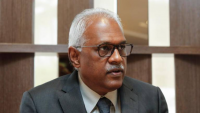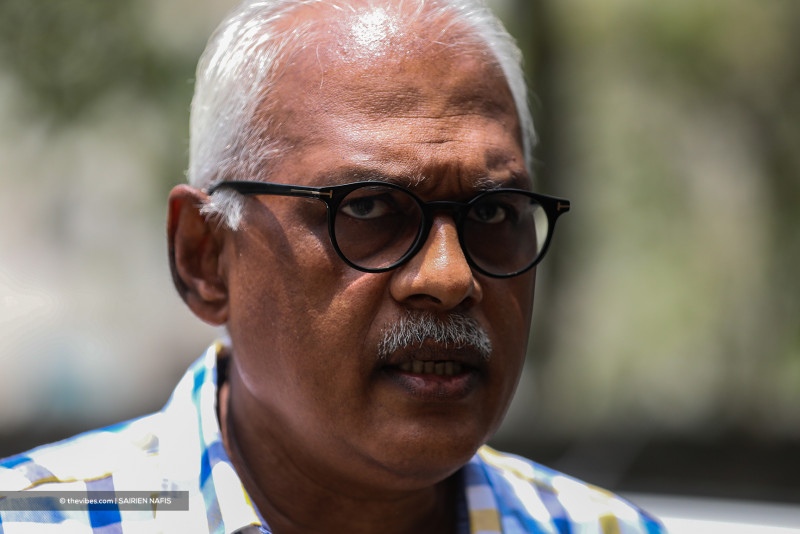
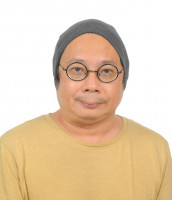
FORMER Klang MP Charles Santiago says a strong political will is needed if the country wants to tap the new global tax rules being negotiated now at the United Nations (UN).
The taxes cover issues such as cross-border tax abuse, illicit financial flows, and how multinational and digital companies are taxed, Santiago said in a statement.
The economist said that under Article 12 of the UN Charter on capacity building, all countries can negotiate as equals.
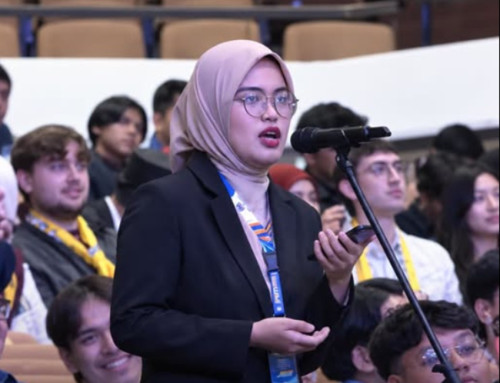
"Before we turn to legal text, look around this meeting room. What we see is the distribution of power. Some delegations arrive with teams of lawyers, tax experts, and seasoned negotiators," he said at the 4th intergovernmental negotiating committee drafting the United Nations framework convention on international tax cooperation (UNTC).
Santiago said others are absent not because they lack knowledge or commitment, but because they lack the resources to be here.
"Those empty chairs matter. They are not accidental. They reflect a system that privileges power and excludes those without it.
And we know the consequence: if you are not at the table, you are on the menu."
This is why Article 12 is not a technical provision, said Santiago.
"It is a political one.
“At its core, Article 12 asks who gets to participate meaningfully in shaping global tax rules.”.
For decades, he said the global tax system has worked well for wealthy states and multinational corporations.
“Capital moves freely, profits are protected, while many countries face eroded tax bases, underfunded public services, and widening inequality.
"This is not accidental. These rules were written in spaces where many countries were never fully present."
Today, global tax norms remain dominated by the OECD and powerful economies.
Much of the Global South is expected to implement frameworks it had little role in designing.
He said Article 12 exists because this imbalance cannot be solved by compliance alone.
“But capacity building must be understood correctly.
“Capacity building must enable countries to participate fully and independently by resourcing attendance, expertise, analysis, and confident negotiation,” he said.
This is a matter of reparative justice as the Global South is still treated as a recipient of expertise, not a co-author of solutions.
If Article 12 is serious, Santiago said it must break from this model through a UN-administered, independently governed, demand-driven funding mechanism that builds long-term capacity.
"Capacity building cannot be an add-on. It must be the foundation of this Convention. Level the playing field, and fairness becomes possible. Fail to do so, and inequality will simply be rewritten into new rules," he added. - February 8, 2026.