
KUALA LUMPUR – The government has no choice but to impose much stricter movement restrictions as public health facilities will soon be swamped by the rising number of Covid-19 cases, says Prime Minister Tan Sri Muhyiddin Yassin.
Echoing Health Director-General Tan Sri Dr Noor Hisham Abdullah's remarks in recent days, Muhyiddin said the country's healthcare system is now at a breaking point.
He said to address the worsening pandemic, it is vital for Malaysia avoid a further spike in cases in a short period of time, as has been the case of late in the country.
“An exponential increase in patients will cripple our existing healthcare system capacity in a blink of an eye. It will no longer be able to accommodate the high number of patients who require treatment, and the mortality rate will continue to increase as a result.
“It’s not easy for me to say all this, but this is the reality, with various possibilities that we may have to face if the situation is not addressed through stricter public health intervention.
“The situation today is indeed very alarming. Our healthcare system is under (more) tremendous pressure now than at any other time since the start of the pandemic. As I have said before, unprecedented situations call for unprecedented measures,” he said in a special address today.
In his address, Muhyiddin announced much stricter movement restrictions, which included the implementation of the movement control order (MCO) in the Federal Territories and five states – the Federal Territories of Kuala Lumpur, Putrajaya and Labuan, Penang, Selangor, Melaka, Johor and Sabah.
According to Muhyiddin, non-intensive care unit (ICU) beds in the 15 Covid-19 hospitals nationwide are currently at 70% capacity.
ICU beds in Kuala Lumpur Hospital have reached full capacity while Universiti Malaya Medical Centre is now at 83%.
ICU beds in five other states – Perak, Selangor, Malacca, Terengganu and Sarawak – have exceeded 70%.
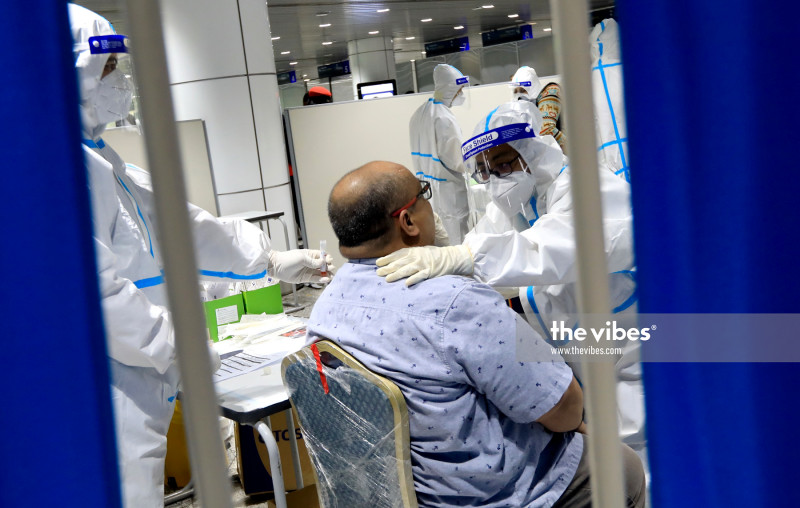
“At the moment, more than 1,450 healthcare workers nationwide are either infected or forced to undergo quarantine and are not able to be on duty.
“The number of deaths also continues to rise, with 551 as of yesterday. We recorded more than 100 deaths monthly from October to December, compared with between just two and 59 deaths a month from March to September.
“This high increase in daily infections have caused delays to healthcare workers picking up patients from their homes to be taken in for treatment. The flood situation in several states is also causing difficulties in mobilising personnel and increasing the number of beds (needed) for critical patients.”
Muhyiddin said since the start of the virus' third wave last September 20, 476 new clusters have been identified, of which 259 are workplace clusters.
He also said that, in the same period, the trend of imported cases has declined, while local infections are increasing, involving Malaysians and foreigners.
“At the start of the third wave, most cases involved non-Malaysians at 63%. However, the latest development shows that infections among locals are more prominent. As of today, 70% of cases involve Malaysians.” – The Vibes, January 11, 2021





.jpeg)