
GEORGE TOWN – A prominent network of civil society groups in Penang has called on concerned citizens alarmed by the Penang Hill cable-car plan’s ambiguity and overdevelopment fears on the state's natural landmark to provide their feedback to the federal authorities.
At a packed online forum last night, representatives of Penang Forum explained some key adverse issues in the replacement edition of the Penang Hill Special Area Plan (SAP).
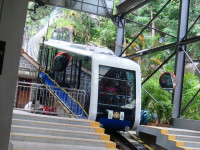
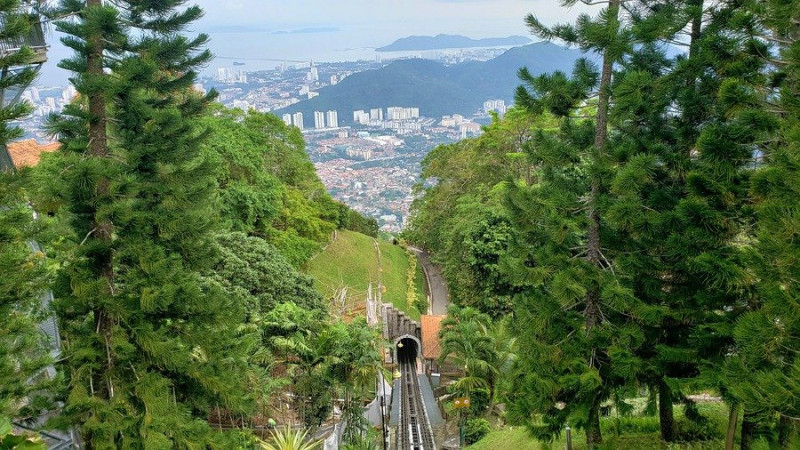
One of the biggest concerns in the SAP 2020 (Replacement) is the state's push to develop the cable car to bring more people up to the summit.
Meenakshi Raman, president of Friends of the Earth Malaysia (SAM), said that there is ambiguity over how the project’s pre-feasibility study in 2020 came up with a carrying capacity of 6,463 persons at any one time.
She noted that the original SAP in 2016 had stated that the hill can only carry 4,800 at any one time.
“The pre-feasibility study was ‘to maximise the potential of the cable car as another tourist attraction and alternative transport to Penang Hill’,” she said, quoting the replacement SAP.
She pointed out that this means the cable car is taken as a given.
“They are using a different methodology to justify the need for a cable car,” she said, explaining that it adopted the “Level of Service” (LOS) approach, a performance metric used for transportation and traffic.
“Then on top of that, if the capacity is reached the ‘Limits of Acceptable Change’ (LAC) process is used,” she further said.
The LAC is usually used to help bring compromise between conflicting goals in a development project, such as in smoothening the development’s contradictions with environmental imperatives.
“In this case, this is not acceptable as there should be no compromise,” she said.
Meenakshi also said the authorities’ motives are suspect.
“We had clarification on how the number in 2016’s SAP was derived, but we had to do ‘forensic work’ to find out how they got 2020’s numbers,” she said.
“This shows that their motives are questionable and lack transparency. The drive and motivation of this carrying capacity seem to be centred around justifying the cable car.”
Environmental activist Rexy Prakash Chacko highlighted concerns on the heritage bungalows on the hill which would be repurposed as boutique hotels with 20 to 30 rooms each.
While repurposing them may be a good idea, Rexy said additional construction of the accommodation would not fit the character of the hill.
The capacity of each hotel should be based on the number of rooms within the bungalow or limited to a maximum of 10 rooms.
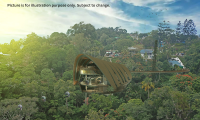
He also expressed concern about the redevelopment of the summit centre to include expansion of Cliff Cafe (Astaka Bukit Bendera eatery) to a four-storey building with a new overhead bridge extended until the historic Bel Retiro bungalow, built in 1789.
He also questioned the wisdom of having a massive flagstaff and a helipad on a cliff.
The idea of such a cement helipad can be replaced with a grassy helipad at Bel Retiro, he said.
Water catchment, landslide risks ignored
But the most troubling missing piece of information in the replacement SAP is the failure to mention one of the original three water catchment areas on the hill in the chapter of the second volume of the SAP
“Why did such a detailed SAP not mention the water catchment area in the Main Protection Zone (ZPU)?” Rexy asked.
“I am zooming on this because it is related to the type of activity that may be allowed (by the government). There is a suggested environmentally-friendly recycling activity in this zone which should not be done in a water catchment area.”
Kam Suan Pheng, a co-founder of Penang Hills Watch, said that more has to be done to prevent landslide tragedies like those that took place in November 2017.
She said the authorities are not tackling the agricultural practices on the hill, when according to the Land Conservation Act 1960 and Penang Enactment No.4 1960 no person shall plant short-term crops on any hill land.
The replacement SAP does not highlight this issue. Instead, it still allows existing agriculture to operate.
Kam questioned if these agricultural activities should still be conserved if they are clearly going against the law.
Retired engineer Ahmad Chik, a resident of Penang Hill, presented concerns about traffic management, such as on jeeps zooming up the hill and buggies making Summit Road their “racetrack”.
He said that a strong traffic management plan should be part of the SAP. Speed humps, speed limits and regulation of vehicles should be looked into.
SAP 2020 (Replacement) is also different from the 2016 SAP in the area covered. The former specifies 742.51 ha while the latter was only for 468.38 ha.
The replacement SAP also divides the hill into eight separate zones.
Penang Forum hopes that Penangites will raise their concerns by submitting feedback to PLAN Malaysia, an agency under the federal Town and Country Planning Department by January 28.
The form can be downloaded from the Penang Forum’s feedback website. – The Vibes, January 24, 2021
.jpeg)

.jpeg)