SANDAKAN – The pandemic has exposed Sabah’s healthcare inadequacy and years of neglect of medical infrastructure, equipment, and human resources, said Sandakan MP Vivian Wong in a statement today.
She proposed that Putrajaya repurpose the RM85.5 million allocation for the Special Affairs Department (Jasa) to upgrade Duchess of Kent Hospital in Sandakan.
She said the hospital could be the second state hospital in Sabah to serve the entire east coast, complimenting Queen Elizabeth Hospital in Kota Kinabalu.
“We do not want shiny new buildings with no doctors or surgeons available. We need a fully operational hospital with the required specialists and doctors based here full time to serve the two million people on the east coast of Sabah.”
Wong said the state needs urgent intervention by the federal government.
She said for example that Sandakan had a ratio of one doctor to 1,369 people last year, three times behind the national ratio of 1:454 as revealed by the health minister in August.
“It is illogical that Sabah, with a 3.9 million population, and the size of Pahang, Perak, and Johor combined, only has one public hospital that offers specialist services such as cardiology and oncology,” said Wong in her recent Budget 2021 debate submission in the Dewan Rakyat.
“The government has a moral obligation to urgently increase its budget allocation for public healthcare in Sabah in order to provide healthcare service standards that match national standards.”
Wong also asked for the federal government to immediately address the sewage treatment facility in Sandakan.
“It is almost unimaginable that Sandakan, the second biggest city in Sabah, and with a total population of more than 500 thousand residents, still does not have a complete centralised sewage treatment facility in 2020,” she said.
“The engineering study and planning for the sewage treatment scheme for Sandakan was done more than 30 years ago back in 1987.
“However, due to priorities elsewhere, only phase one of the scheme, which covered the northern and southern section of the town, was completed in 1995.”
Wong said phase two, which covers the central section, was still on the drawing board after nearly three decades.
“Sandakan’s urban population has increased over threefold from 150,000 to nearly half a million since 1990,” she said.
“The number of residential units in town has also increased. Yet, our centralised sewage treatment facility has never been upgraded in tandem with our population growth.
Sandakan, she said, currently holds the notorious record of having the one and only marine outfall in the whole of Sabah.
“To make matters worse, we have hundreds of gazetted water villages built without proper sewerage systems. A recent water quality study along the Kg Sim-Sim coastline conducted by local environmental NGO Future Alam Borneo had shown worrying results," said Wong.
“The e. coli count along the Sim-Sim coast was 2,800 colony-forming units (CFU) per 100ml, way above the standard 300 CFU per 100ml set by the Environment Department. The amount of fecal coliform detected in the water is 228 times higher than Malaysian marine water quality standards.
“These are the consequences of discharging untreated sewage and other human waste directly into the sea. Most viruses are water-borne, so how effective can our fight against Covid-19 be when we cannot provide a clean environment for the people to live in?"
Wong urged Putrajaya to expedite phase two of the Sandakan sewerage scheme and resume the Kg Sim-Sim sewerage pilot scheme, which has been put on hold since March.
"This is critical for public health and the safety of the rakyat.”
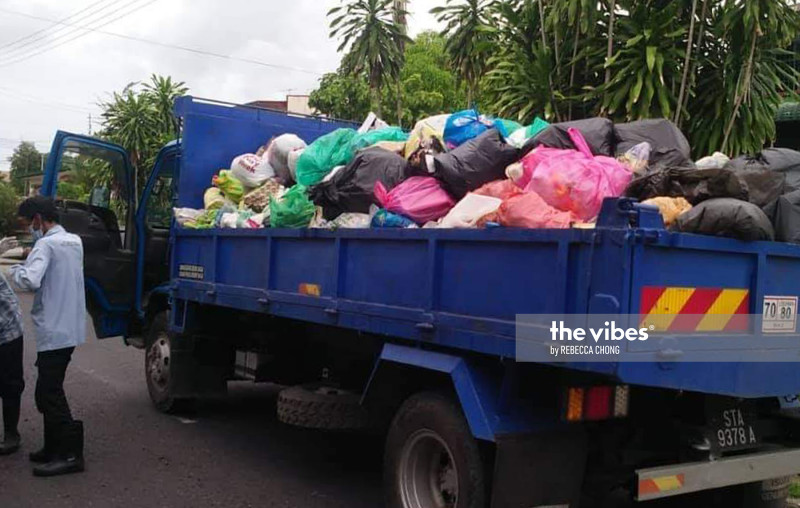
Wong also said that dump sites in Sandakan have no leachate treatment or landfill gas treatment facilities.
“I want to stress that this dumpsite is nothing like those properly managed landfill facilities found in other parts of Malaysia; about 400 tonnes of rubbish are sent to the site daily and are piling up to become a man-made rubbish mountain now.”
“This leads to serious environmental pollution and huge safety and health hazards to the surrounding communities.
“Sg Seguntor, located right next to the dumpsite, has become one of the most polluted rivers in Sandakan, not to mention the potential contamination to our groundwater as a result of lack of leachate treatment.”
“There is an illegal village (squatter settlement) with a few hundred people living within the dumpsite, scavenging recyclables from the rubbish pile.
“I cannot imagine how many million pieces of used face masks have been sent to this dumpsite to be disposed of since March this year. And we have a whole village living off on this dumpsite, and perhaps hundreds of thousands face masks have already found their way into our rivers and sea.” – The Vibes, November 23, 2020