KUCHING – Every month on her payday, Kak Nor (not her real name) would have to buy two small packets of sanitary pads.
The Kg Gita resident usually purchases the cheapest brands for her household, namely for herself and her 17-year-old daughter.
The 53-year-old single mother, who works as a cleaner, regards sanitary pads as a necessity.
During that time of the month, she would make sure to bring extra pads to work.
“I must have the extra pads – I really need them because of the physical nature of my job.
“I want to avoid ‘leakage’; I want to stay clean at all times.
“If I run out of pads, I would ask my friends at work. I would pay them back by the end of the month upon getting my salary.
“But I don’t pay them back in cash; I would ‘repay’ them with new pads.
“If not (if my co-workers did not have any pads with them), I would have to skip work, but I rarely do it – unless I have period cramps,” she told The Borneo Post in Kuching recently.
Much-needed relief
When the government’s plan of providing complimentary sanitary pads as a way to combat ‘period poverty’ was shared with the public on December 12, many women like Kak Nor welcomed the idea.
Health Minister Dr Zaliha Mustafa was quoted as having said that as a start, the initiative would be implemented at her office in the Health Ministry (MoH) building in Putrajaya.
“We will start at the minister’s office first, and after that (we will expand it) throughout the ministry.
“And then, maybe we could cooperate with other agencies and ministries,” Dr Zaliha told reporters when met after the MoH monthly assembly recently.
On this initiative, Kak Nor said should it be made accessible to the public, it would be a “much-needed relief” to low-income earners like herself.
“The price of sanitary pads is high now. I buy the cheapest brand, with the smallest pack containing 10 pads costing about RM10.
“For those who earn more, maybe they find this cheap, but I’m just a cleaner – I don’t earn that much.
“Still, I am grateful. At least, I have income every month because I have three children to feed and care for at home,” said Kak Nor.
Sharing similar sentiments, Suzaifa Ellisha said such an initiative would help all women, especially young girls.
“Aok, perlu kak (yes, we need that, big sister),” said the 24-year-old waitress, who is very familiar with the idea of free sanitary pads.
The Feast & Furious Café at Jalan Padungan in Kuching, where Suzaifa has been working for six months now, has a small box filled with free sanitary pads placed in the women’s washroom.
Part of her weekly duties is to refill the box when it is nearly empty.
According to her, the feedback from the customers has been “overwhelmingly positive”.
“When their period arrives, the female customers would rush to the toilet. They would ask us if the pads in the toilet were free.
“As I said before – free pads are necessary,” said Suzaifa, who hails from Lundu.
Struggle is real
The United Nations Population Fund describes period poverty as “the struggle that many low-income women and girls face while trying to afford menstrual products”.
The term also refers to the increased economic vulnerability that women and girls face due to the financial burden posed by menstrual supplies – these include not only sanitary pads and tampons but also other related items such as medications and also women’s inner garments.
According to Datin Shentel Lee, the founder of Kuching Food Aid, whenever her team receives the lists of things that needy folk want from the donations, often no one requests for sanitary pads.
“They only ask for food and drinks, as well as other essential items.
“Some will ask for diapers for their babies,” she said.
Kuching Food Aid is a non-profit group that helps vulnerable communities acquire food aid and donations.
Lee’s team is now working with Sarawak Women for Women Society (SWWS) to advocate for women and young girls from poor communities to use feminine hygiene products through a Sanitary Protection Donation Drive campaign.
Under this drive, which has been running since February, sanitary pads are included among the donated items meant for the local communities, both in the urban and rural areas.
Talking more about period poverty, Lee said her team on the ground had discovered that the lack of accessibility to sanitary products and also the increased retail prices of these items had adversely affected the B40 groups during the Covid-19 pandemic.
“Whenever we go out for our donation drive, we’d be asked about the bigger (sized) sanitary pads. Now I have heard stories about them wanting bigger-sized pads because they want to save them.
“With bigger pads, they can wear them for the whole day. Sometimes, the women would cut the big pads in half.”
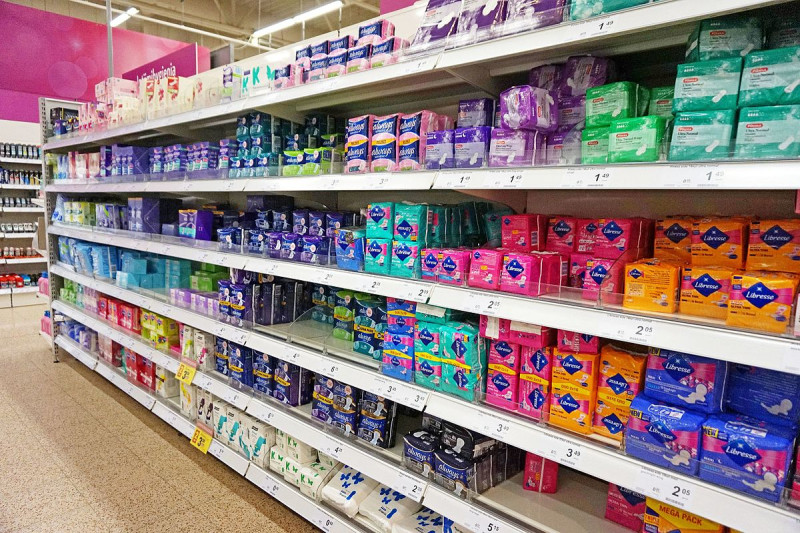
Lee also lamented the huge price gaps between different types of pads.
“Just go to the supermarket and see the prices, they’re different.
“It is a sad thing because it (price range) is very huge – and confusing as well.”
Lee said she had heard many stories about how period poverty affects young girls.
“I’ve heard that they would wear towels or other types of fabrics, which they would pin onto their undergarments.
“Should a girl experience a heavy flow, she would skip school because of not having the proper pad to wear,” she said.
Argument on sustainability
Nevertheless, Lee also acknowledged the conflicting issues amid discussions over period poverty.
She said while she supports the effort to provide free sanitary pads, this alone would not be sufficient in addressing the issue of sustainability.
“There is a lack of data – I agree. There are more things than just the pads.
“I’ve been talking to SWWS about the ‘period underpants’ being a much more sustainable way, which is something that is happening now.
“The world is changing away from sanitary pads,” said Lee.
On this subject, SWWS president Angie Garet said combating period poverty would require more holistic plans and measures.
She echoed Lee’s point about the need for the government to focus on educating the public about menstrual health and feminine hygiene.
“Yes, I agree with Lee. We have not researched this issue in depth. We have only posed questions on social media and collected comments.
“The initiative by MoH should focus on menstrual health and hygiene. With regard to this issue, they (MoH) can do research on rural girls and women.”
Economic perspective
Prominent economist Datuk Madeline Berma is not convinced that giving out free sanitary pads would help combat period poverty.
She argued that such an initiative would only make more poor women rely on a limited range of products, despite the availability of other alternatives.
“Let’s assume that there’s a family of five – two of them are female students and each uses a pack of sanitary pads. The total cost (for both) is a cost to the family.
“My question is, why must we teach them to rely on pads when we know they are poor?
“There are other alternatives to ‘cover’ period blood,” she said.
Madeline added that while there is no in-depth data, that does not mean that period poverty is a non-issue.
“It is an issue because we talk about poverty; it’s always income-centric, and there’s very limited research done on health-related poverty, especially period poverty.”
On the whole, Madeline stressed that it is important to understand the context and the meaning of the terms used.
“Indicating terms without any clear meaning could lead to an allegation.
“What I want to stress here is that young girls in Sarawak and Sabah have dropped out of school not because of period poverty.
“There is a difference between ‘miss out’ and ‘drop out’ of school. Missing out means that they just miss the class. Drop out means they don’t go to school anymore.
“Even if you could find one young girl who had dropped out of school because of period poverty, it’s still a very weak claim.
“Out of two million young girls, only one has dropped out. You cannot generalise it.”
Nonetheless, Madeline said she is not trying to portray period poverty as a non-issue.
“It is an issue, but it has to be understood in different contexts.
“Yes, they (girls) do miss their classes, but they don’t drop out of school.
“Some dropped out of school not just because of period poverty – there are various factors.
“The lawmakers must be able to understand this clearly and know how to contextualise the issue.
“The lack of treated water supply in rural areas – this is also difficult to counter.
“What if they use rain or water from the mountains?”
Madeline also argued about women’s sanitary products having only existed in the modern days.
“Fifty years ago, those from the older generation like my mother, used to wear cloth towels, which they would wash and use, again and again. It’s reusable and recyclable.
“The only difference now is we choose to use sanitary pads because we think they are the most hygienic; that’s why we subscribe to the idea that having pads is important.
“But for the rural people like those living in the longhouse, they have their own ways that have been in practice for many years.
“It doesn’t mean that the cloth towels they’re using during their menstruation are dirty. In fact, each towel cloth is specially prepared – they sew each piece and attach it onto the underwear,” she said.
Madeline also stressed that while she understands the good intention behind the fight against period poverty, the government should be concerned about the risk of poor folk shifting to commercial products.
“What makes period poverty a problem is because once these women rely on sanitary products, they would need access; (it is) when they don’t have access would this become a problem – too much dependence on the disposable pads.
“We have become the consumers, we purchase everything nowadays, and we have become very used to everything that we are buying now.
“In the old days, we invented, we innovated; now, we have become the consumers. This is a shift in behaviour.
“It becomes more difficult for those living in rural areas. First, the cost is high, and second, accessibility.
“This is a problem because they have shifted away, from reusable (towel cloths) to commercial disposable products like sanitary pads,” she argued. – Borneo Post Online, December 27, 2022












.jpg)