CHINA is intensifying economic and strategic engagement with North Korea in a calculated effort to restore its traditional influence over the isolated state, as new infrastructure projects, rising trade volumes and renewed diplomatic exchanges signal a cautious thaw in relations.
The shift follows years of strained ties between Beijing and Pyongyang, during which North Korean leader Kim Jong Un moved closer to Russia after the 2022 invasion of Ukraine. In recent years, North Korea has reportedly supplied troops and weapons to Moscow in exchange for fuel and food, helping sustain its heavily sanctioned economy.
However, a recent series of high-level visits and new border developments suggest Beijing is moving to regain leverage over its long-time neighbour as global diplomatic dynamics evolve.
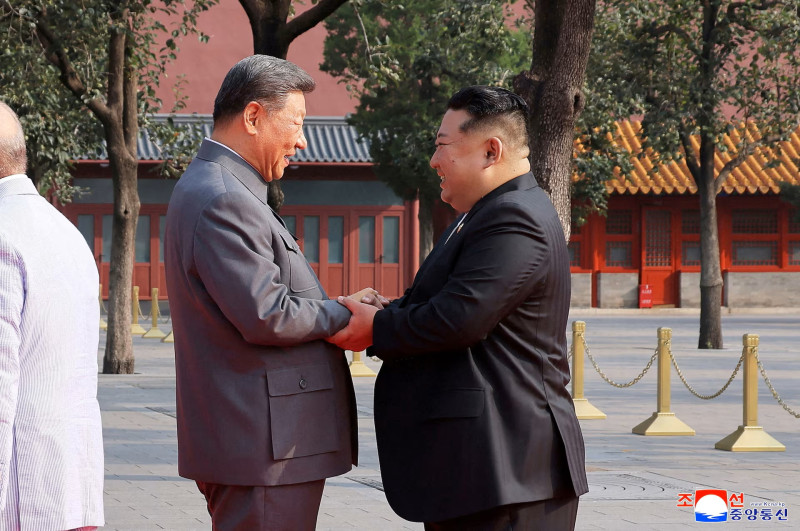
Reuters reported on Wednesday that Kim’s arrival in Beijing by armoured train for a military parade in September was widely seen as a symbolic turning point in the relationship.
Behind the pageantry of tanks and fighter jets, the North Korean leader reportedly travelled with senior economic officials to discuss trade and investment with Chinese counterparts.
Five weeks later, Chinese Premier Li Qiang visited Pyongyang, while China’s ambassador declared that the two countries were “writing a new chapter”.
The renewed engagement comes as U.S. President Donald Trump signals interest in reviving talks with Kim Jong Un for the first time since their 2019 diplomatic summit process stalled.
A Reuters investigation found evidence of expanding cross-border cooperation, including new infrastructure and trade activity along the 1,350-kilometre frontier shared by the two countries.
Satellite imagery revealed construction of roads, logistics facilities and port infrastructure on both sides of the border, some developments not previously reported.
The investigation combined trade data analysis, satellite imagery and on-the-ground reporting along sections of the border. Journalists also interviewed dozens of individuals including Chinese business owners operating factories in North Korea, North Korean service workers, Western tour operators and a Chinese government official.
The renewed rapprochement remains cautious. North Korea closed its borders in 2020 during the COVID-19 pandemic and has yet to fully reopen to tourism, although passenger train services between China and North Korea are resuming for the first time in six years.
Analysts say the revival of transport links and infrastructure preparations indicate that both governments are preparing for a gradual expansion of trade and economic interaction.
In the Chinese border city of Dandong, preparations for increased cross-border traffic are already visible. Satellite images show new road markings labelled “Truck Entry Lane” and “Passenger Vehicle Entry Lane” at the long-unopened New Yalu River Bridge linking Dandong with the North Korean city of Sinuiju.
Additional construction work has also been identified at several other Chinese border crossings, including road upgrades and new facilities at ports such as Quanhe, Nanping and Sanhe.
On the North Korean side, analysts say Pyongyang has been building what appears to be a customs and immigration complex near the bridge, alongside warehouse and cargo-transfer buildings. Satellite imagery suggests construction progressed throughout much of last year before appearing to pause in November.
Trade figures also reflect the warming relationship. China’s exports to North Korea reached a six-year high of US$2.3 billion last year, representing a 25 per cent increase from the previous year.
In a message to Chinese President Xi Jinping earlier this month, Kim expressed optimism about the future of bilateral cooperation.
Cooperation between the two countries “will become even closer in the future as we advance the common cause of socialism,” North Korean state media quoted Kim as saying.
Academic observers say dialogue between the two governments has expanded beyond trade.
“Discussions across all areas - politics, economy, security, and military - have kicked off, laying ground for relations to take a leap,” said Lim Eul-chul, a professor specialising in North Korean studies at Kyungnam University in South Korea.
Meanwhile, Russia has publicly welcomed China’s engagement with Pyongyang. Kremlin spokesman Dmitry Peskov told Reuters that Moscow views greater regional cooperation positively, saying it contributes to stability and security.
China’s foreign ministry confirmed that cross-border cooperation with North Korea is being expanded, stating that the two countries are “actively advancing border cooperation” to facilitate exchanges.
Economic activity along the frontier also reflects a gradual revival of cross-border commerce. Chinese trucks carrying goods such as cloth, soybean oil, tyres and frozen meat continue to cross the Sino-Korean Friendship Bridge, while small businesses in Dandong sell souvenirs featuring North Korean imagery and memorabilia.
Experts say Beijing’s renewed engagement with Pyongyang may also reflect a longer-term strategic calculation: ensuring that China remains the primary external power capable of influencing North Korea’s political and economic direction, particularly as Washington considers renewed diplomatic outreach.
At the same time, evolving trade patterns highlight how China has adapted to international sanctions targeting North Korea’s traditional exports such as coal and minerals.
Labour-intensive goods such as wigs, false eyelashes and artificial beards have emerged as a major component of bilateral trade, now accounting for nearly half of China’s imports from North Korea. According to analysts, imports of such products have surged dramatically over the past decade as Beijing shifts toward sectors less directly targeted by sanctions.
Together, the infrastructure projects, rising trade and diplomatic overtures suggest a carefully managed recalibration of relations between Beijing and Pyongyang, one that could reshape regional dynamics as major powers compete for influence over the isolated nuclear state. - March 11, 2026






_leader__Sanae_Takaichi.jpg)