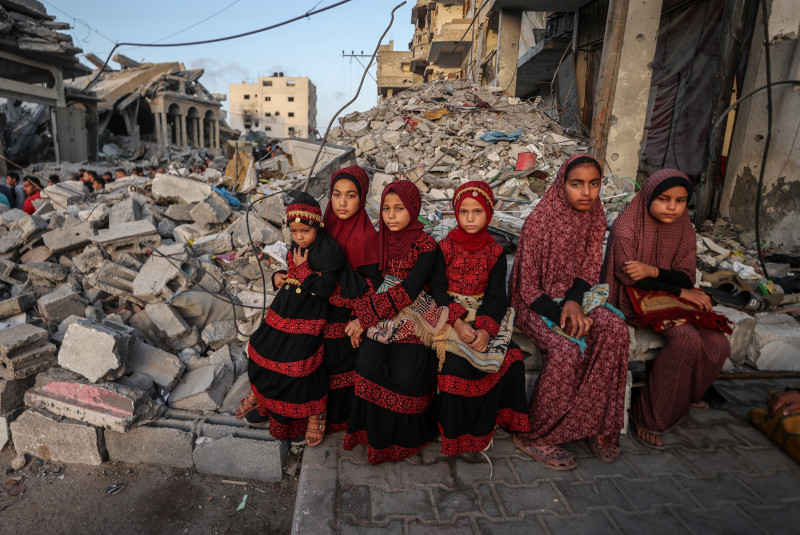
FOR many families across the Gaza Strip, Eid al-Adha has become less a celebration of faith and togetherness than a painful reminder of war, loss and deepening hardship.
As Muslims worldwide begin commemorating the four-day religious festival, residents in the besieged enclave say the traditions once associated with the holiday — particularly the ritual sacrifice of livestock — have all but disappeared under the weight of conflict, displacement and economic collapse.
For Palestinian resident Ahmed Nashwan, the arrival of Eid no longer brings anticipation or joy, but memories of a life disrupted by years of war and deprivation.
“Before the war, Eid al-Adha was a joyful occasion for us,” Bernama-Xinhua reported him saying.
“We used to gather as a family to select the sacrificial animal, prepare for the holiday, and distribute meat to relatives and poor families.”
Now, he said, those traditions have vanished.
“Now the holiday has been reduced to prayers and memories for us because there is no livestock entering Gaza, and most people can barely secure daily food.”
Although a ceasefire agreement between Israel and Hamas was reached in October 2025, residents and traders say strict restrictions on goods entering Gaza have continued to cripple daily life and severely limit supplies of essential commodities, including livestock needed for Eid sacrifices.
According to Gaza Chamber of Commerce director Maher al-Tabbaa, the price of sacrificial animals has surged to unprecedented levels.
He said a single animal that once cost roughly US$500 before the war now sells for between US$6,000 and US$7,000, placing it entirely beyond the reach of ordinary residents.
The collapse of family traditions has been particularly devastating for parents attempting to preserve a sense of normalcy for their children.
Mohammed al-Hissi, a father of four from Gaza City, said Eid al-Adha had once been among the happiest periods of the year for his family.
“Eid al-Adha was always one of the happiest times for our family. My children used to wake up early, wear new clothes, and accompany me to visit relatives after we distributed the meat,” he said.
“But today, everything has changed because of the war and the worsening humanitarian conditions in Gaza.”
“Most families can no longer think about buying sacrificial animals because prices are extremely high and people have lost their incomes and homes.”
In southern Gaza, 22-year-old Mohammed Shallah stood beside his father’s grave in Khan Younis, reflecting on celebrations before his father was killed in an Israeli airstrike.
“We used to go together with my father and relatives to choose sacrificial animals,” he said.
“Even if livestock can still be found, the prices are extremely high. I cannot afford to buy a sacrificial animal anymore.”
Livestock trader Salah Afana said the war had devastated the sector, with many animals killed during airstrikes while feed shortages and the collapse of veterinary services further worsened conditions.
“Many animals died because of airstrikes, feed shortages, and the collapse of veterinary services. At the same time, no livestock has entered Gaza because of the crossing closures,” he said.
Hamas-run Agriculture Ministry spokesperson Raafat Asaliya said Gaza previously imported between 10,000 and 20,000 calves and up to 40,000 sheep annually ahead of Eid al-Adha.
“With the war and the closure of crossings, imports stopped completely,” he said, adding that livestock farms, barns and feed warehouses had also been heavily damaged during the conflict.
Al-Tabbaa warned that the destruction of livestock production areas in eastern Gaza had dramatically reduced local supply, leaving residents without access to one of the central practices of the Islamic holiday.
“The population of Gaza has been deprived of sacrificial animals for the third consecutive year,” he said.
“No one knows how many more Eid al-Adha holidays without sacrifices Gazans will have to endure.” - May 27, 2026