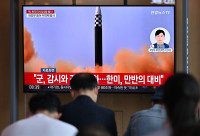
SEOUL – North Korea has tested a new “tactical guided projectile” with a solid-fuel engine, state media said today after the nuclear-armed country carried out its first substantive provocation since United States President Joe Biden’s inauguration.
Pyongyang has a long history of using weapons tests to ramp up tensions, in a carefully calibrated process to try to forward its objectives.
Yesterday, it launched two weapons from its east coast, with Japanese Prime Minister Yoshihide Suga calling them ballistic missiles.
Pyongyang is under multiple international sanctions over its weapons programmes, with United Nations Security Council resolutions banning it from developing ballistic missiles.
Biden told reporters that UN resolution 1718 “was violated by those particular missiles that were tested”.
Pyongyang had been biding its time since the new administration took office, not even officially acknowledging its existence until last week.
The US was “consulting with our partners and allies”, Biden said yesterday, warning North Korea that “there will be responses if they choose to escalate”.
“We will respond accordingly. I’m also prepared for some form of diplomacy, but it has to be conditioned upon the end result of denuclearisation,” he added.
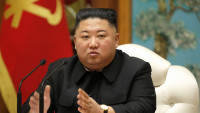
The firing was supervised by senior official Ri Pyong-chol, the official KCNA news agency reported, rather than leader Kim Jong-un.
It was successful with the two projectiles accurately hitting a target 600km into the Sea of Japan, known as the East Sea in Korea, it added – further than the 450km reported by South Korea’s military.
KCNA said the weapon could carry a payload of 2.5 tons, in a dispatch that avoided using the words “missile” or “ballistic”.
The test had confirmed the reliability of an improved solid fuel engine, KCNA added.
Pictures in Pyongyang’s official Rodong Sinmun newspaper showed grinning officers applauding after the launch from a vehicle, most of them not wearing masks.
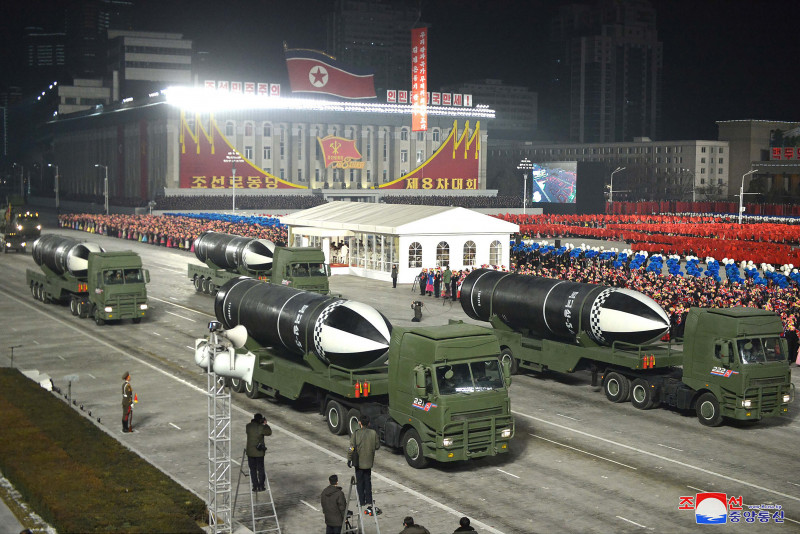
Vipin Narang of MIT said it appeared to be a weapon that the North displayed at a military parade in January.
“A 2.5 ton warhead likely settles the question whether this KN23 variant is nuclear capable. It is,” he tweeted.
The test was “of great significance in bolstering up the military power of the country”, KCNA cited Ri as saying, “and deterring all sorts of military threats existing on the Korean peninsula”.
The US stations 28,500 troops in the South to defend it against its neighbour, which invaded in 1950, while Pyongyang says it needs nuclear weapons to deter a possible US invasion. – AFP, March 26, 2021