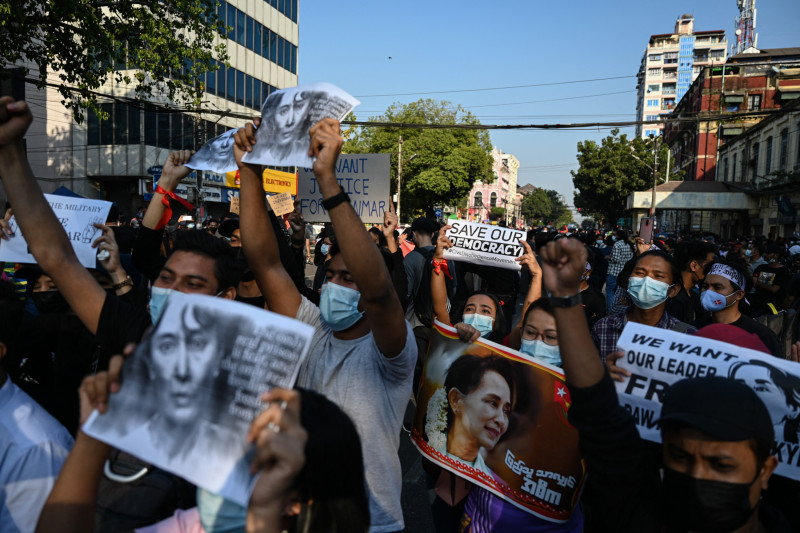
NEW YORK – The United Nations General Assembly yesterday took the rare step of calling on member states to “prevent the flow of arms” into Myanmar, part of a non-binding resolution condemning the military coup in the violence-wracked country.
The resolution – which did not go so far as to call for a global arms embargo – also demanded that the junta “immediately stop all violence against peaceful demonstrators”.
It was approved by 119 countries, with 36 abstaining including China, Myanmar’s main ally. Only one country, Belarus, voted against it.
The call came on the same day that the Security Council held informal talks on the situation in the Southeast Asian nation, where the military ousted civilian leader Aung San Suu Kyi on February 1.
The resolution was not passed by consensus, as had been hoped, but rather through a vote, forcing all 193 UN countries to reveal their views.
In a quirk of history, Myanmar’s envoy to the world body, Kyaw Moe Tun, voted in favour of the text. He has passionately rejected the coup and brushed aside the junta’s claims that he no longer represents Myanmar. The UN still considers him as the rightful envoy.
After the vote, the diplomat voiced regret that it had taken three months for the assembly to adopt the resolution, and that it was not more explicit about an arms embargo.
Among the countries that abstained were Russia, Mali – where a second military coup in less than a year recently took place – Iran, Egypt, Brunei, Cambodia, Laos and Thailand.
The General Assembly very rarely adopts resolutions condemning military coups or calling for limits on the arms supplied to the target country.
“It is the broadest and most universal condemnation of the situation in Myanmar to date,” said Olof Skoog, the European Union’s ambassador to the UN.
The EU is proud of the resolution just adopted by the UN General Assembly. It sends a strong and powerful message. It delegitimises the junta, condemns its abuse and violence against its own people, and demonstrates its isolation in the eyes of the world.”
The resolution also urged for a restoration of democracy in Myanmar, and the release of all detained civilian leaders.
“We absolutely must create the conditions for democracy to be reinstated,” said UN Secretary-General Antonio Guterres before the vote on the resolution, hoping for a “very clear message” from the assembly.
‘Do the obvious’
The resolution sought the implementation of a five-point plan drafted by Asean in April, including the naming of an envoy from the bloc.
The text also called on the junta to allow the UN envoy to Myanmar, Christine Schraner Burgener, to visit the country, and for the safe passage of humanitarian aid.
Burgener briefed the Security Council during its closed-door meeting on Myanmar yesterday. No joint statement was adopted at that meet because of persistent divisions between its members, diplomats told AFP.
The assembly’s resolution “calls on UN member states to do the obvious: stop providing weapons to Myanmar”, said Human Rights Watch (HRW).
“Months of atrocities and grave human rights abuses by the junta’s security forces have shown time and again why no government should be sending them a single bullet. The UN Security Council should now step up and pass its own resolution imposing a global arms embargo on Myanmar,” said Louis Charbonneau, UN director at HRW.
The resolution is an opportunity “to show that the world stands with the people of Myanmar, and not the military” that has “committed horrific acts of violence against ordinary civilians”, said Barbara Woodward, Britain’s envoy to the world body.
More than 860 civilians have been killed in Myanmar since the coup, according to the UN and Association for the Assistance of Political Prisoners. – AFP, June 19, 2021