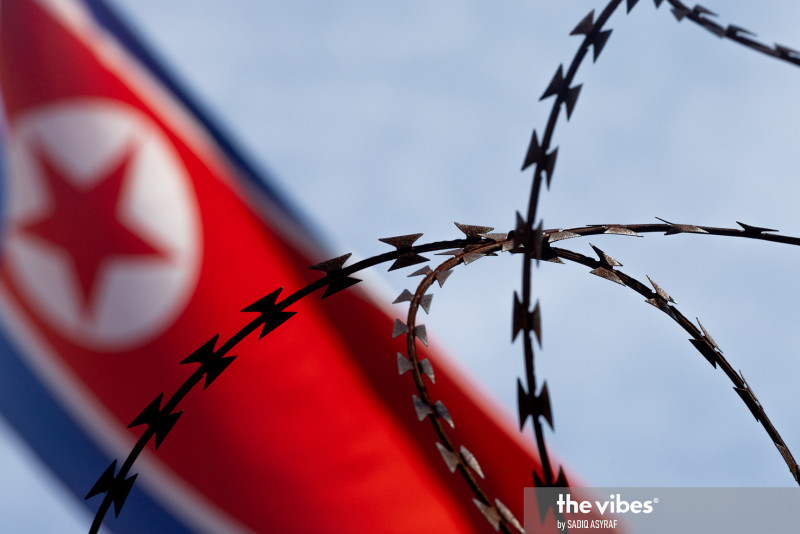
UNITED NATIONS – China and Russia yesterday blocked a US push to impose United Nations (UN) sanctions on five North Koreans in response to recent missile launches by Pyongyang, diplomats said.
China’s block came before a new closed-door Security Council meeting on North Korea, also requested by Washington, and was followed by Russia’s decision to similarly oppose the American proposal.
Along with Beijing, Moscow has long held a line against increasing pressure on North Korea, even asking for relief from international sanctions for humanitarian reasons.
Last week, after Washington levied sanctions on five North Koreans linked to the country’s ballistic missile programme, the United States undertook a campaign within the 15-member Security Council to extend UN sanctions to those same five people.
The US Treasury Department said one of the North Koreans, Choe Myong-hyon, was based in Russia and had provided support to North Korea;s Second Academy of Natural Sciences (SANS), which is already subject to sanctions.
Also targeted were four China-based North Korean representatives of SANS-subordinate organisations, the Treasury Department said: Sim Kwang-sok, Kim Song-hun, Kang Chol-hak, and Pyon Kwang-chol.
The US quickly expressed its displeasure at the block.
Washington has accused all five North Koreans of ties to the country’s weapons programme, and yesterday the US envoy to the UN warned that failing to mete out sanctions equated to a “blank check” for Pyongyang.
“We have these sanctions for a reason,” ambassador Linda Thomas-Greenfield said when asked about the Beijing and Moscow opposition.
“And for any member state to oppose putting sanctions...gives, in my view, the DPRK a blank check,” she said, using an acronym for North Korea.
‘We need more time’
Under current UN rules, the block period lasts for six months. After that, another council member can extend the block for three more months and one day, before the proposal is permanently removed from the negotiating table.
North Korea has launched a series of missile tests, asserting its “legitimate right” to self-defence.
Yesterday’s Security Council meeting on North Korea, the second in 11 days, was devoted to discussing a “response to the latest tests”, according to Thomas-Greenfield.
“We have to respond to them. These actions are unacceptable,” she told the Carnegie Endowment for International Peace, a research institute.
China’s diplomatic mission to the UN did not immediately respond to a request for comment. Russia demurred as well.
“We need more time to study the data,” Russia’s deputy UN ambassador Dmitry Polyanskiy said.
Last week, failing to reach consensus for a unanimous statement at the Security Council’s first meeting after North Korea conducted a hypersonic missile launch test, the US, Albania, France, Ireland and Britain, along with Japan, had jointly called on Pyongyang to refrain from any further destabilising action.
It responded with more missile tests.
Yesterday the same six countries, joined by new council members Brazil and the United Arab Emirates, issued a joint statement urging fellow members to be “unified in condemning the DPRK”.
According to diplomats, the US sought to have the text adopted at the meeting but China refused.
The three-sentence statement, obtained by AFP, notes that the latest North Korean launches used “ballistic missile technology” and were “in violation of Security Council resolutions”.
It also urged Pyongyang to comply with its council obligations and to “engage in dialogue towards denuclearisation”.
Earlier in the day, North Korea hinted it could resume its nuclear and long-range ballistic missile tests, as top officials led by Kim Jong-un said the country was preparing for a “long-term confrontation” with the US, state-run media reported.
China said Monday it had reopened its border with North Korea for freight train trade, some two years after it was shuttered by Pyongyang because of the coronavirus pandemic. – AFP, January 21, 2022







_leader__Sanae_Takaichi.jpg)