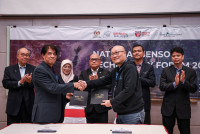
KUALA LUMPUR – Malaysia, through the Malaysian Industry-Government Group for High Technology (MIGHT), and Turkish Aerospace Industries Inc (TAI) have entered into a cooperation agreement to promote capacity building and capability in the aerospace industry.
The Science, Technology and Innovation Ministry, in a statement today, said the cooperation agreement between the two countries, via the signing of the letter of intent, was witnessed by Prime Minister Datuk Seri Ismail Sabri Yaakob and Turkish President Recep Tayyip Erdogan, at the Presidential Palace, Ankara, yesterday.
Science, Technology and Innovation Minister Datuk Seri Dr Adham Baba, who is currently accompanying Ismail Sabri on the official visit, said his ministry supports the cooperation between MIGHT and TAI.
“The ministry believes that the most important element in ensuring Malaysia’s transformation to a high-technology nation, is to strengthen collaboration and coordinate business models to explore the latest technologies,” he said in a statement today.
Meanwhile, MIGHT joint chairman (industry), Tan Sri Ahmad Tajuddin Ali, said that the continuous cooperation between TAI and Malaysia, which was facilitated by MIGHT, had encouraged the transfer of knowledge in the field of UAVs (unmanned aerial vehicles), space and aircraft to Malaysian experts from various agencies and industries.
He added that the cooperation could serve as a catalyst for Malaysia in the production of the country’s high-tech products, further reducing dependence on foreign procurement in strategic areas, such as defence and security.
“This is also a right step in realising Malaysia’s aspiration to restore its dominance in technology development in the global market,” he explained.
Yesterday, Ismail Sabri visited TAI, which is the Turkiye Excellence Centre to design, develop and modernise aircraft and UAVs, as well as satellite and space subsystems.
TAI opened an engineering and design office in Cyberjaya last year, and about 20 Malaysian engineers are already training at this office.
The largest defence and aerospace company in Turkiye is also committed to training another 100 local engineers soon. – Bernama, July 8, 2022