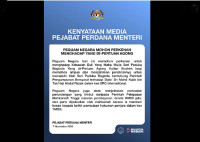
THE Attorney General’s Chambers (AGC) rejected allegations that it defied a royal decree from the Yang di-Pertuan Agong, Sultan Ibrahim, regarding the implementation of a conditional pardon for former Prime Minister Datuk Seri Najib Tun Razak.
Instead, the AGC maintains that seeking a court clarification on the legal implications of the order for Najib’s release was a responsible step, taken to ensure that the execution of his prison sentence and the conditional pardon are carried out in accordance with the law.
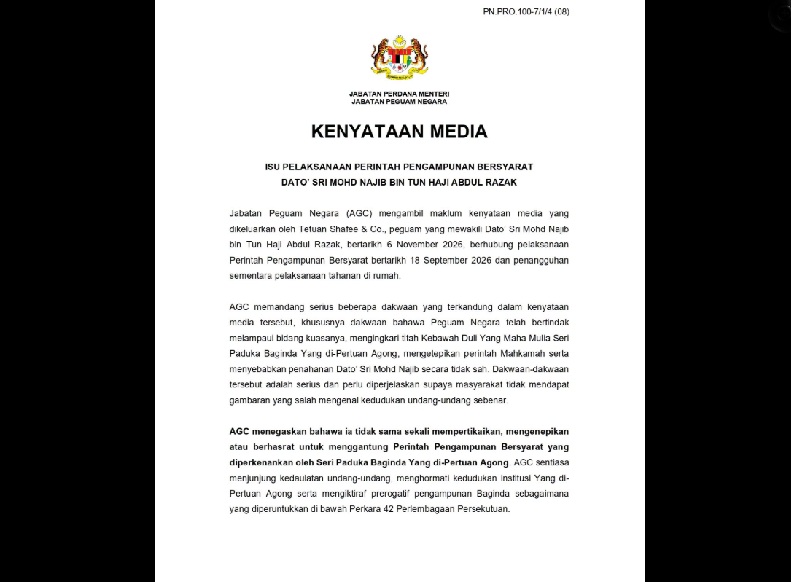
According to the AGC, it has never disputed, set aside, or intended to suspend the Conditional Pardon Order granted by the Yang di-Pertuan Agong.
“The AGC views with seriousness the use of expressions that characterise the actions of the Attorney General as an act of contempt or treason against His Majesty the Yang di-Pertuan Agong.
“Such allegations are groundless, given the legal issues raised by the AGC,” the department said in a statement today.
The AGC stated that the issue requiring a court determination does not concern the validity or authority of the pardon order dated 18 September 2026, but pertains to the legal effect of the release order issued by the Kuala Lumpur High Court yesterday.
This concerns the question of whether Najib’s prison sentence in the SRC International case remains in effect or has been legally concluded, as well as the implications this has for the commencement date of his prison sentence in the 1Malaysia Development Berhad (1MDB) case.
The issue arose after Najib paid a RM50 million fine yesterday, which led to the issuance of an "Order of Discharge on Payment of Fine" by the Kuala Lumpur High Court.
The order states that Najib may be released immediately following the payment of the fine.
However, it also specifies that he must serve the remainder of his sentence under house arrest until August 23, 2028, in accordance with the terms of his conditional pardon.
The AGC stated that this situation raises the question of whether the release order relates solely to the payment of a fine, thereby allowing the remainder of the sentence in the SRC International case to be served via house arrest, or whether it implies that the sentence in that case has been fully served.
According to the AGC, this matter is directly linked to the prison sentence in the 1MDB case, which the High Court ordered to commence only after the sentence in the SRC International case has been completed.
An application for a stay of execution of the sentence in the 1MDB case was also dismissed by the High Court on October 14.
“This issue carries distinct legal implications and should not be decided based on assumptions or one-sided interpretations,” the statement read.
The AGC further clarified that the Yang di-Pertuan Agong’s power of pardon, under Article 42 of the Federal Constitution, is separate from the courts’ authority to interpret and determine the legal effect of an order.
Therefore, seeking clarification from the court cannot be equated to usurping or challenging His Majesty’s prerogative of mercy.
“The AGC maintains that the appropriate avenue to resolve this matter is through a court of competent jurisdiction, so that a clear decision and implementation directive can be obtained without undermining the standing of any institution,” the statement noted.
The AGC added that an expeditious determination by the court is also essential to safeguard Najib’s own rights.
It explained that if the court rules that the sentence in the SRC International case has been served, continuing his detention based on that sentence could result in Najib being held beyond the legally permitted duration.
Conversely, if the sentence remains in effect, its execution must strictly adhere to the terms of the Conditional Pardon Order and any relevant court orders.
“This step is not intended to delay or obstruct the implementation of the Conditional Pardon Order; rather, it aims to prevent conflicts in the execution of prevailing orders and to ensure that no sentence is carried out unlawfully,” the statement affirmed.
The AGC also rejected allegations that the Attorney General had acted beyond his jurisdiction or caused Najib to be detained unlawfully, stressing that such claims should not be made without a clear factual basis.
The AGC stated that the responsibility of ensuring that a royal pardon is implemented accurately and in accordance with prevailing court orders is part of the effort to uphold the institution of the Yang di-Pertuan Agong and the rule of law.
It emphasised that it does not intend to engage in a public exchange of allegations regarding matters that should be determined through the judicial process; instead, it remains committed to ensuring that every sentence is carried out lawfully, systematically, and accurately. – November 6, 2026