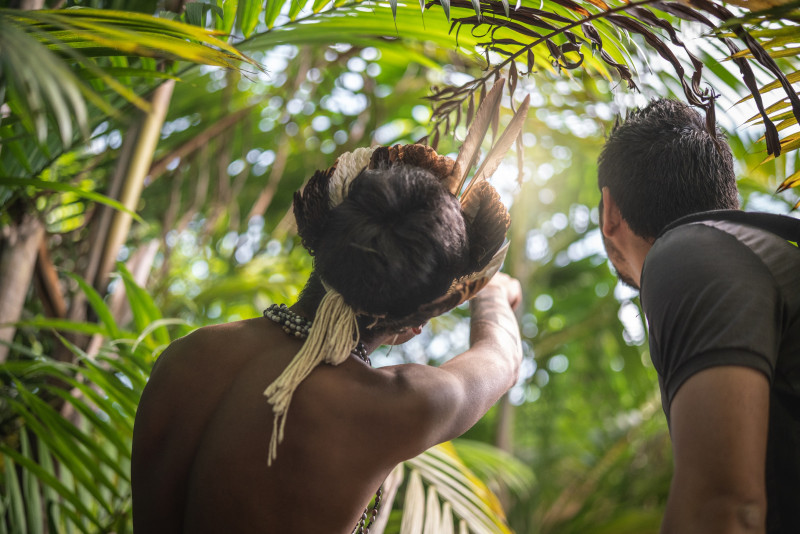
COULD knowledge of natural plant-based remedies disappear along with indigenous languages? So suggests Swiss research conducted among more than 50 communities in America and Oceania.
From relieving stomach aches, to treating fungal or respiratory infections, plants are full of medicinal virtues. These are properties that many indigenous peoples of America, Asia or Africa know well, as they largely depend on plants for food, shelter and treatment.
But this knowledge could be at risk of disappearing at the same time as indigenous languages, according to new research published in the PNAS journal.
According to the United Nations, more than 30% of the 7,400 languages spoken in the world are at risk of dying out by the end of the century. The extinction of these languages would also cause a massive loss of knowledge.
"Much of the focus looks at biodiversity extinction, but there is a whole other picture out there which is the loss of cultural diversity," Dr Rodrigo Cámara-Leret, a biologist from the University of Zurich, who led the research, told The Guardian.
The study reviewed 12,000 properties associated with medicinal plants and described in 230 indigenous languages spoken in North America, the Northwest Amazon and New Guinea. According to the researchers, 73% of the medicinal knowledge in North America was found in only one language.
In the northwestern Amazon and New Guinea, these estimates rise to 91% and 84% respectively.
Language extinction threatens cultural and biological heritage
The researchers consider that the results obtained in these regions will be similar in other parts of the world. They go on to state that: "Language loss will be even more critical to the extinction of medicinal knowledge than biodiversity loss."
Indeed, unlike Western societies, where information is transcribed in handwritten or digital books and documents, most indigenous languages are transmitted orally, which explains why the knowledge associated with them could disappear in the process.
"Our findings pave the road toward integrative policies that recognize more explicitly the inseparable links between cultural and biological heritage," the researchers conclude.
ETX Studio spoke to the journalist, anthropologist, and specialist in indigenous studies, Sabah Rahmani, who welcomed the study. "This research demonstrates concretely, supported by figures, what I have been observing for 25 years in the field.
"Indigenous peoples, as well as their language and culture, have been threatened since the arrival of colonization. However, language is the first vector of culture and cosmology, that is to say, the vision that each people has of its environment.
"It is also a vector of energy and spirituality. Words are not only used to name an object and to give it an intellectual dimension: they also transmit a culture, a vision of the world. For example, a plant will be used in a specific way by a community and a vocabulary will be associated with it to communicate in songs, prayers, incantations etc.
"The data provided in this study can therefore be valuable in encouraging the creation of legislative tools aimed at listing and protecting traditional pharmacopoeia, so that it is not patented by the large pharmaceutical industries," she said. – ETX Studio, June 15, 2021