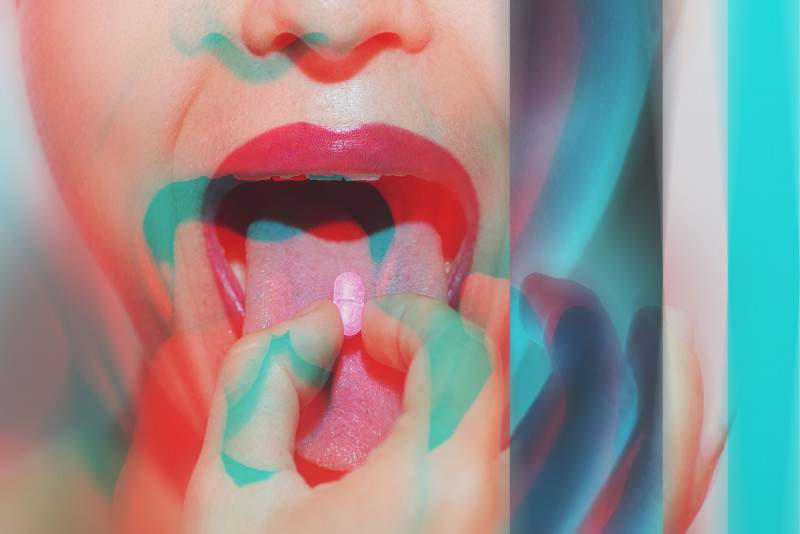
FOR years, scientists have been looking ever more seriously at the therapeutic effect of psychedelics, which are not legal under US federal law. However, despite this renewed interest, large-scale studies are still lacking.
On Wednesday, researchers took an important step to fill this gap.
Their work, published in the New England Journal of Medicine, is the largest clinical trial ever conducted to evaluate the effect of psilocybin, a psychoactive substance found naturally in "magic" mushrooms.
A single dose of 25 milligrams reduced symptoms of depression in people for whom several conventional treatments had failed, they showed.
An estimated 100 million people worldwide suffer from treatment-resistant depression. Some experts view psychedelics as a possible way to help them.
The researchers tested a synthetic version of psilocybin developed by the start-up Compass Pathway, which also funded the trials.
A total of 233 people in 10 countries took part in the study, during which they halted ongoing treatment but received psychological support.
They were divided into three groups, randomly receiving 1 milligram, 10 milligrams or 25 milligrams of the treatment.
The sessions, in a dedicated room, lasted between six and eight hours during which the participants were never left alone. Some described being immersed in "a dream-like state" that could be remembered, study co-author James Rucker told a news conference.
One participant required a sedative during the session because of anxiety. But the side effects observed – headaches, nausea, anxiety – were generally moderate and disappeared quickly.
Larger trials needed
Three weeks later, patients who received 25 mg showed significant improvement compared to lower doses on a baseline measure for depression. Just under 30% were in remission.
"It is the strongest evidence so far to suggest that further, larger and longer randomised trials of psychedelics are justified, and that psilocybin may (one day) provide a potential alternative to antidepressants that have been prescribed for decades," said Andrew McIntosh, professor of psychiatry at the University of Edinburgh.
McIntosh was not involved in the study.
The phase 2 trials were designed to determine the dosage and confirm the existence of an appropriate effect.
Phase 3 trials, involving more participants, are scheduled to begin this year and run until 2025. The startup is already in touch with the US Food and Drug Administration and regulators in Europe.
Another expert offered caution.
"We don't yet know enough about the potential side effects, particularly whether some people may experience a worsening of some symptoms," said Anthony Cleare, a professor of psychopharmacology in London, who was not involved in the study.
In the trials, three participants showed suicidal behaviour among those who received 25 mg, compared with none in the other groups.
These events, however, occurred more than 28 days after treatment, noted Guy Goodwin, professor of psychiatry at Oxford and chief medical officer of Compass Pathways.
"Our hypothesis is that the differences are by chance... but we can only settle this by doing further experiments," he said.
The matter of long-term impact also remains open, as it faded when the participants were followed up three months later. Repeated doses may be necessary. Two doses will be tested in future trials, Goodwin said.
‘More flexible state’
Taking psilocybin leads to an increase in dopamine (known to regulate mood) and another neurotransmitter that may promote brain plasticity, Rucker said.
"When the brain is in a more flexible state, it opens what we consider to be a therapeutic window of opportunity, in which – in the context... of psychotherapy – you may be able to elicit positive changes in the minds of people," Rucker said.
Psilocybin promotes "more communication between brain regions," added Nadav Liam Modlin, also a co-author of the study.
Psilocybin, which is not addictive, is also studied for other pathologies including post-traumatic stress, anorexia, anxiety and addictions.
In 2020, the state of Oregon voted in favour of the therapeutic use of psilocybin. Exemptions have also been granted in Canada.
But at the US federal level, psilocybin is treated as a dangerous drug in the same category as heroin. – AFP, November 6, 2022















.jpeg)