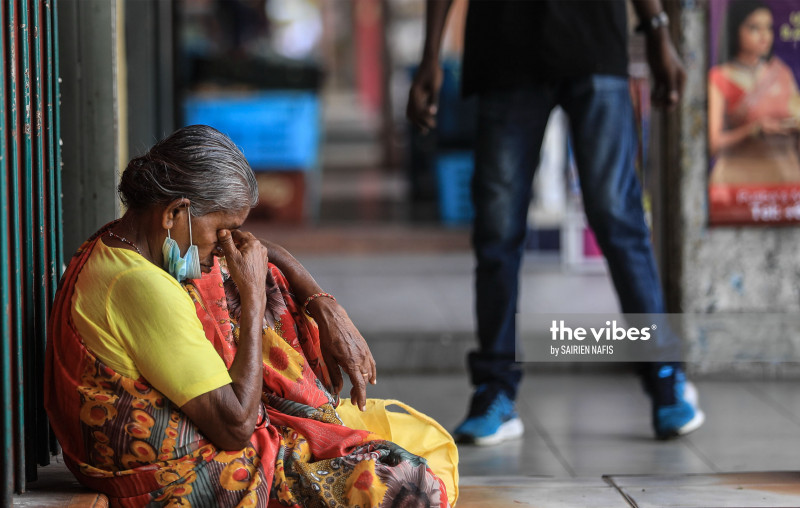

KUALA LUMPUR – Budget 2021 can be a lifesaver for some of the country’s most vulnerable if certain proposals are implemented, such as allowing withdrawals from the Employees Provident Fund (EPF) Account 1 and a monthly allowance for B40 families that have found themselves with zero income, said civil groups.
They warned that poverty is an increasingly grave problem given the business closures and retrenchments over the months due to the Covid-19 pandemic, which has shown no sign of abating.
Food Aid Foundation founder Rick Chee told The Vibes that the proposal to allow EPF Account 1 withdrawals is a “good idea” as it would put cash in the hands of desperate folk and allow money to circulate in the economy, especially with the end of the six-month bank loan moratorium in September adding to the people’s hardship.
“The problem is getting bigger as many who were previously paid a daily wage are suffering the most. They have gone eight months without work. These are people who washed cars, they were cleaners.
"Even the masseurs from the Malaysian Association for the Blind have had no business in months. So, the government must look into this and decide.”
He acknowledged that EPF savings are meant as a financial safety net in one’s golden years, but said the current situation calls for unprecedented solutions.
“What’s the point of saving for old age when people are suffering and dying now?”
The money will help revive the battered economy, he said.
“It will help create more jobs and kick-start the economy so that the market can move, especially for those who live hand to mouth.”
Chee said Putrajaya can introduce various incentives for hard-hit businesses, including hotels and small and medium enterprises, to spur them to hire those presently unemployed.
“Ultimately, if they don’t operate, they will not be able to generate money to pay taxes to the government, and the government will find itself with no income.”
In turn, he said, the government may be forced to borrow money, leading to a hike in the prices of goods.
“Then, the people will blame the government because they don’t understand why they are paying higher prices for things like medication.”
Allowance not to encourage laziness
Parti Sosialis Malaysia secretary-general Sivarajan Arumugam proposed a RM1,000 monthly allowance for poor households that have lost all sources of income.
“Our proposal is that the government should back up those on the lowest rung, and not only with small benefits or Socso (Social Security Organisation) payments.
“Without any money in their pockets, these families cannot survive. The RM1,000 is like a ladder they can climb to help them get back into the job market.”

There are an estimated two million to three million families in the B40 category, he said, but not all have lost their income completely.
He said the cash aid is not “for people to become lazy”, but to give those who are badly off a shot at regaining employment or reopening their businesses.
Sivarajan added that the government should hire people out of a job to work as support staff with the Health Ministry, which is on the front line of the fight against the coronavirus.
“This will help reduce the burden on nurses and other hospital staff when it comes to tasks that require minimal training.”
‘Better country for women’
In a September blog post titled “Budget 2021 must make Malaysia a better country for women”, the Women’s Aid Organisation (WAO) said there is a need for Putrajaya to address female participation in the labour force.
This includes prioritising subsidised adult education and lifelong learning programmes for women who have lost their jobs, and amendments to the Employment Act 1955 to prohibit discrimination against employees and job-seekers on the basis of gender, ethnicity, age and disability.
The group also called for a seven-day paternity leave, increasing paid maternity leave to 90 days and protecting workers’ right to a flexible work arrangement.
“I hope that the Budget will prioritise spending for those who are most vulnerable in our communities. This pandemic disproportionately affects at-risk women, children without internet access, and informal and self-employed workers,” said senior research and advocacy officer Yap Lay Sheng.
In a recent survey of 1,010 working women in Malaysia, WAO found that stress arising from the virus crisis has adversely impacted female employees, with 79% reporting an increased burden in domestic and unpaid care work.
Of this cohort, said Yap, almost all reported a loss of income or employment as a result.
“It is time their needs and voice are mainstreamed in the development agenda.” – The Vibes, November 5, 2020