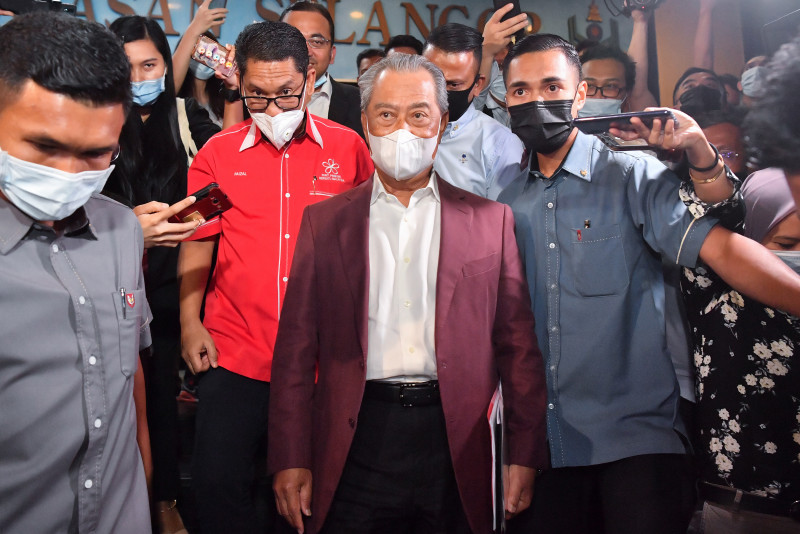

WITH the pull-out of several Umno MPs, many have come out to state that the prime minister has lost majority support among Dewan Rakyat members.
In a televised speech on Friday, Tan Sri Muhyiddin Yassin appeared to admit that he has lost the majority, and urged all opposition MPs to support his premiership and come to his aid when a confidence vote is held in Parliament.
My take on these events is simple.
Firstly, to qualify as and to be considered a prime minister candidate, that person must evince to the Yang di-Pertuan Agong that he or she commands the confidence of the majority of Dewan Rakyat members as stated under Article 43(2) of the federal constitution.
After having been appointed prime minister, there is a continuing obligation of the prime minister to show that he still commands the confidence of the majority of MPs if challenged. In this regard, his command of the majority can be questioned and put to the test at any time during his premiership.
Article 43(4) of the constitution states that in the event the reigning prime minister ceases to command the confidence of the majority of MPs, the prime minister shall tender his resignation unless, at his request, the king dissolves Parliament. The implications of Article 43(4) are as follows:
If the prime minister ceases to command the majority, which appears to be so in the present circumstances, he is mandatorily required to tender his resignation. In other words, he has no choice but to resign. In this regard, there is precedent in the case of Dato Seri Mohammad Nizar Jamaluddin v Dato Seri Dr Zambry Abdul Kadir 2010, where the Federal Court ruled that it is incumbent on a leader to tender his resignation as he cannot continue to govern after having lost the confidence of the majority. So, it is not up to the prime minister whether he should resign.
However, if the king chooses to dissolve Parliament on the request of the prime minister, then he holds the office of the prime minister as part of a caretaker government until the conclusion of a general election, in which event, he may be appointed again by the king, but subject to him proving to the king that he still commands majority support among the newly elected MPs.
The Agong has discretion as to whether to dissolve Parliament, as Article 55(2) of the constitution states that His Majesty may dissolve it.
What if the prime minister refuses to tender his resignation? According to Article 43(4), when the prime minister has lost the confidence of the majority of MPs, he is deemed to have vacated his position as prime minister. In this regard, the king does not have to wait for him to tender his resignation, and instead, may proceed to appoint another person who, in His Majesty’s view, commands the confidence of the majority of MPs.
The issue of whether the king can sack or dismiss the prime minister does not arise. Again, as in the case of Dato Seri Mohammad Nizar Jamaluddin v Dato Seri Dr Zambry Abdul Kadir 2010, where the Federal Court followed the case of Datuk (Datu) Amir Kahar Tun Datu Haji Mustapha v Tun Mohd Said Keruak & Ors 1995, which ruled:
“If the chief minister refuses or does not tender the resignation of the members of the cabinet, which includes himself, or if he tenders the resignation of himself alone, the fact remains that the cabinet is dissolved on account of him losing the confidence of the majority of the members of the assembly, and it is not necessary, therefore, for the Yang di-Pertua Negeri, as a last resort, to remove the chief minister and the other members of his cabinet.”
Additionally, it is not for the prime minister to state that he is unable to tender his resignation, because at present, there is no other person who commands the confidence of the majority of MPs. That would be usurping the powers of the king, as it is only for His Majesty to decide whether there is such a person who has the support of the majority. – The Vibes, August 15, 2021
Datuk Seri Rajan Navaratnam is a prominent lawyer