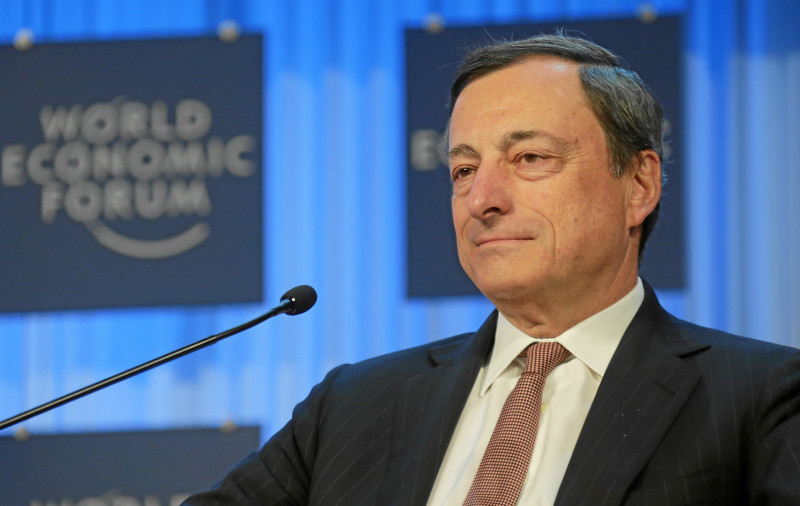
ROME – Former European Central Bank (ECB) chief Mario Draghi will be sworn today as Italy’s new prime minister, charged with guiding his country through the devastation wrought by the coronavirus pandemic.
The 73-year-old – known as Super Mario for doing “whatever it takes” to save the eurozone – has put together a national unity government involving almost all Italy’s political parties.
He was parachuted in by President Sergio Mattarella after the previous centre-left coalition under premier Giuseppe Conte collapsed, leading Italy rudderless at a critical time.
Italy is battling the pandemic that hit one year ago, leaving more than 93,000 people dead and triggering the country’s deepest recession since World War II.
Draghi has spent the last 10 days assembling a broad-based coalition and last night formally accepted the post of prime minister in a meeting with Mattarella.
He spoke only to read out a list of his cabinet – a mix of technocrats, veteran politicians and existing ministers – but will return today to be formally sworn in at the presidential palace.
Following today’s swearing-in, Draghi will be presented to the upper-house Senate on Wednesday followed by the Chamber of Deputies on Thursday for a confidence vote which will give the final official blessing to his government.
Draghi has the support of a rainbow coalition ranging from leftists to Matteo Salvini’s far-right League.
It includes the populist Five Star Movement (M5S), the centre-left Democratic Party (PD) and Italia Viva, who made-up the previous government and then fell out over the handling of the Covid-19 pandemic.
M5S – the biggest party in parliament which began life as an anti-establishment movement – was split over whether to support a government led by an unelected technocrat.
But in an online vote, members backed Draghi by 59%, after securing the promise of a new super-ministry for “ecological transition”.
That post has gone to renowned physicist Roberto Cingolani, who works at Italian aeronautics giant Leonardo.
Bank of Italy senior deputy governor Daniele Franco was named as the new economy minister, while Roberto Speranza and Luigi Di Maio stay on at health and foreign affairs, respectively.
Italy has high hopes for its new leader, who himself has no political power base but can count on his experience during years working in the Italian civil service as well as his banking career.
His arrival was greeted with delight by the financial markets, and Italy’s borrowing costs dropped to a historic low this week.
Nevertheless, “it is difficult to overstate the scale of the challenges that Draghi and Italy face”, said Luigi Scazzieri of the Centre for European Reform.
The Covid-19 shutdown and waves of subsequent restrictions caused the economy to shrink by a staggering 8.9% last year, while more than 420,000 people have lost their jobs.
The virus remains rife and Conte’s cabinet, in one of its last acts, tightened curbs in four regions and extended a ban on travelling between regions.
Like other European Union (EU) countries, Italy has also fallen behind in its vaccination programme, blaming delivery delays.
The country is pinning its hopes on receiving more than €220 billion (RM1.08 billion) in EU recovery funds to help get back on its feet.
But disputes over how to spend the money – between demands for longstanding structural reform and short-term stimulus – brought down the previous government.
Draghi’s job looks easier than that faced by previous technocrat prime ministers, such as Mario Monti in 2011, who turned to severe and unpopular austerity measures during the debt crisis.
“But spending funds is not enough,” noted researcher Scazzieri, adding that the new premier “will find it just as challenging to enact long-called for reforms”. – AFP, February 13, 2021