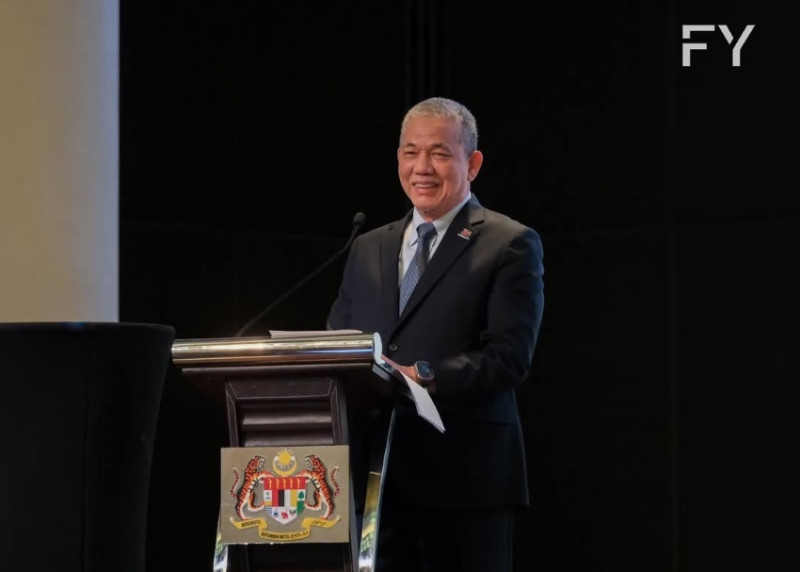

DEPUTY Prime Minister Datuk Seri Fadillah Yusof reaffirms Malaysia’s commitment to regional cooperation, safe atomic governance, and long-term clean energy strategies at the officially opened the 12th Annual Meeting of the ASEAN Network of Regulatory Bodies on Atomic Energy (ASEANTOM) in Johor Bahru on Monday,
Presiding over the ceremony, Fadillah, who is also Minister of Energy Transition and Water Transformation, welcomed delegates and dialogue partners from across ASEAN and beyond, describing the gathering as an important moment for the region.
“ASEANTOM has become a respected platform for nuclear governance, capacity building, and technical cooperation,” said Fadillah.
Malaysia currently chairs both ASEAN and ASEANTOM, and under the 2025 theme of “Inclusivity and Sustainability”, is committed to promoting unity and long-term, responsible planning across the region.
“This meeting takes place at a defining moment,” said Fadillah. “The clean energy transition is accelerating, climate resilience is a pressing priority, and emerging technologies are reshaping the energy landscape.”
He noted the growing international interest in nuclear and other advanced energy technologies as low-carbon alternatives but stressed the importance of strong regulatory safeguards. “Their deployment must always be underpinned by strong regulatory frameworks, rigorous safety protocols, and transparent international cooperation.”
ASEANTOM, he added, plays a critical role in this regard. “Our regulators have worked closely with the IAEA and partners to harmonise safety standards, strengthen emergency preparedness, and invest in human capital.”
Fadillah also outlined Malaysia’s domestic nuclear energy agenda, noting that the Government is conducting a comprehensive assessment of nuclear power as part of its long-term energy planning, following the 13th Malaysia Plan (RMK13).
“This initiative aims to diversify energy sources, support carbon reduction targets, and ensure long-term energy security,” he said.
The Nuclear Energy Programme Implementing Organisation (NEPIO), led by MyPOWER Corporation, is coordinating the preparatory phase in line with IAEA guidelines. The effort involves national positioning, legal frameworks, stakeholder engagement and capacity building, all carried out through inter-agency coordination.
“The Government’s priority is to ensure that any future consideration is grounded in comprehensive technical analysis, aligned with national development priorities, and in full compliance with international obligations,” said Fadillah.
He further announced that Malaysia would soon launch the Gamma Spectrometry Water Monitoring System (GSWMS) under the 12th Malaysia Plan — a technology designed to detect radiation in water sources and strengthen environmental monitoring.
Reaffirming Malaysia’s long-standing support for nuclear disarmament, he called on nuclear-weapon states to ratify the Protocol to the Southeast Asia Nuclear-Weapon-Free Zone (SEANWFZ) Treaty. “A strong, enforceable nuclear-weapon-free zone remains a vital pillar of regional peace, mutual trust, and long-term security,” he said.
He concluded by highlighting the strategic importance of the region’s nuclear cooperation. “Our cooperation under ASEANTOM is not merely technical; it is deeply strategic. It reflects our shared responsibility to ensure that atomic energy serves sustainable development, strengthens regional stability, and secures the well-being of our future generations.”
Fadillah formally declared the meeting open and wished delegates a productive week of discussions and collaboration. - August 11, 2025