FOR much of the past decade, Malaysia’s reform agenda was defined by promise rather than delivery.
Policy blueprints were announced, mega-projects debated and structural changes deferred. In 2025, that pattern shifted decisively, as the country moved from prolonged discussion to concrete action across multiple fronts.
The year stood out not for gradual adjustment but for a concentration of long-delayed breakthroughs.
Economic restructuring, digital governance, infrastructure delivery and institutional reform converged in a way not seen in recent history, marking a clear break from years of political caution and administrative inertia.
At the heart of this shift was Malaysia’s entry into formal artificial intelligence governance.
The launch of the country’s first national AI framework set standards for ethics, safety, data usage, model training and public-sector deployment.
More than 200 government agencies began structured AI readiness assessments, while AI literacy was formally embedded into secondary and tertiary education.
By the end of the year, 81 per cent of micro, small and medium enterprises were using AI tools to address operational and commercial challenges, signalling that adoption had moved beyond pilot programmes into the mainstream economy.
Equally transformative was the government’s decision to dismantle blanket subsidies, a reform debated for more than two decades.
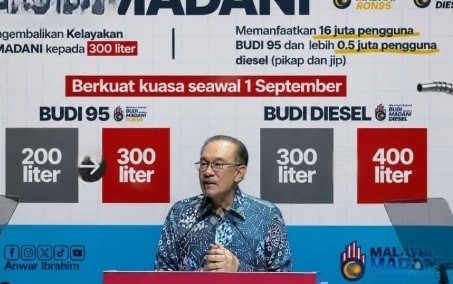
In 2025, Malaysia implemented a nationwide targeted subsidy system, beginning with fuel.
The Budi Madani RON95 scheme, rolled out in stages from September, allowed Malaysians aged 16 and above with a MyKad and a valid driving licence to purchase subsidised petrol at RM1.99 per litre, capped at 300 litres a month.
Alongside this, a one-off RM100 payment was distributed to all Malaysians aged 18 and above between Aug 31 and December.
The move marked Malaysia’s first true attempt at structural subsidy reform, reshaping how public funds are distributed.
Malaysia’s digital economy also gained global momentum.
The country emerged in 2025 as one of the Asia-Pacific region’s fastest-growing data centre destinations, with Penang and Johor establishing themselves as core technology hubs.
The data centre and cloud sector contributed RM30.95 billion in digital investments, while 143 projects were approved by mid-year.
Global technology firms including Microsoft, Google and Amazon Web Services confirmed major investments, while YTL Power International partnered Nvidia to develop AI infrastructure, with an AI data centre in Johor becoming operational.
Hyperscale specialist AirTrunk added to the momentum by announcing a second cloud and AI-ready facility in Iskandar Puteri.
After 15 years of political debate and repeated delays, infrastructure delivery finally caught up with ambition when construction began on the Penang Light Rail Transit project.
Awarded construction packages and early works along the Bayan Lepas–George Town corridor paved the way for viaduct construction starting in early 2026.
Once completed, the line will link industrial zones, residential areas, Universiti Sains Malaysia, the international airport and George Town, addressing one of the country’s most persistent urban transport bottlenecks.
The energy transition also moved from planning to production. In July, Malaysia launched its first commercial-scale green hydrogen hub in Terengganu through a collaboration between Petronas, Tenaga Nasional Berhad and Terengganu Inc, under the National Energy Transition Roadmap and the Hydrogen Economy and Technology Roadmap.
In Sarawak, the Darul Hana H2 Plant began producing around 150 kilograms of hydrogen per day via electrolysis, marking one of the first instances of green hydrogen produced in Malaysia being exported, including to Singapore.
In manufacturing, Malaysia entered a new phase of automotive production when Proton launched the country’s first electric vehicle assembly plant in Tanjong Malim.
The facility positions Malaysia within the regional EV supply chain, with the national carmaker also exploring the production of Zeekr electric vehicles at the same site.
Institutional reform extended to border governance. In February, Malaysia established the Malaysian Border Control and Protection Agency, or AKPS, consolidating responsibilities previously spread across 20 agencies.
For the first time, a single authority took charge of national border control. The agency began operations overseeing 22 checkpoints and is expected to manage 114 entry points by 2026, with the aim of improving security, facilitating trade and travel, and enhancing service delivery.
Consumer protection advanced with the passage of the Consumer Credit Bill 2025 in August.
The legislation paved the way for the Consumer Credit Act, bringing Buy Now Pay Later providers under formal regulatory oversight for the first time and strengthening safeguards for both consumers and businesses in a rapidly expanding credit market.
Malaysia also stepped onto the diplomatic stage in an unprecedented way. During the Asean summit in Kuala Lumpur, the country hosted the signing of its first peace treaty.
US President Donald Trump, on his first visit to Malaysia, witnessed the formalisation of a ceasefire agreement between Thailand and Cambodia alongside Malaysian Prime Minister Datuk Seri Anwar Ibrahim.
The agreement ended a deadly border conflict that had erupted earlier in July, underscoring Malaysia’s growing role as a regional diplomatic convenor.
Demographic realities were also addressed with the launch of Malaysia’s first National Ageing Blueprint, covering the period from 2025 to 2045.
With the country projected to become an aged nation by 2030, the blueprint outlines strategic priorities across the economy, employment, education, social protection, healthcare and long-term care.
It also serves as a guiding framework for the Public Service Department in improving services for pensioners nationwide.
Collectively, the developments of 2025 marked a decisive break from years of hesitation.
Across policy, infrastructure, technology and social planning, Malaysia shifted from deferred ambition to tangible execution, setting a new direction that will shape the country’s economic and institutional landscape well into the next decade. - December 27, 2025