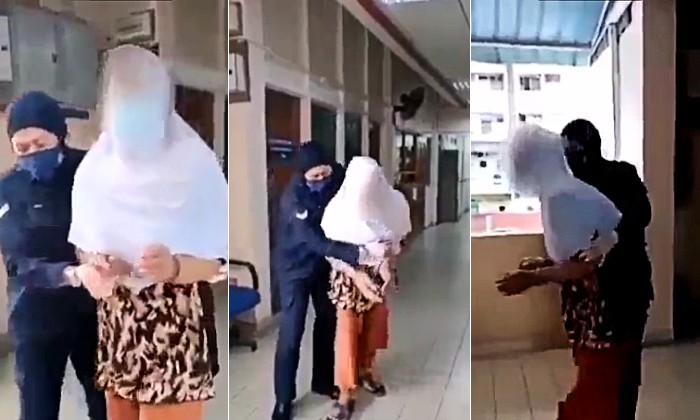

KUALA LUMPUR – The debate surrounding the mandatory death penalty has picked up after a viral video of a single mother sobbing in Tawau after she was sentenced to death following a drug conviction surfaced recently.
Ever since the Pakatan Harapan (PH) federal administration first highlighted the issue, various human rights groups have consistently pushed for the abolishment of capital punishment, and the heartbreaking clip of the crying woman has once again sparked discussions.
Today, calls to drop the contentious punishment have once again intensified.
Speaking to The Vibes, lawyers urged for an amendment to the law to return discretionary powers to judges in passing sentences on drug-related offences.
Presently, those found guilty of drug trafficking are sentenced to mandatory death.
This is after the Tun Dr Mahathir Mohamad-led Barisan Nasional (BN) government had, in 1983, introduced a number of amendments for harsher penalties under the Dangerous Drugs Act 1952.
However, after assuming federal power in 2018, PH vowed to abolish the practice and imposed a moratorium on all forms of executions.
Mandatory sentencing removes judges’ wisdom
Human rights lawyer Andrew Khoo said judges must once again be allowed to exercise their judicial discretion in sentencing drug offenders based on mitigating factors, which are now not given consideration.

He said under the current practice, the law takes away judges’ ability to apply their knowledge and expertise in meting out punishment.
“The whole idea of training and having judges is so that they can apply their wisdom to certain situations. When you introduce mandatory sentencing, you totally remove this core value of a judge. Their hands are now tied,” he said.
“In these kinds of situations, there is no room for mitigating circumstances. The court is all about dispensing justice, but just mechanically applying the law is not dispensing justice. Instead, injustice is bound to happen.”
Khoo was commenting on the viral video of a 55-year-old single mother of nine breaking down and crying for help after she was sentenced to the mandatory death sentence last Friday for possession and distribution of illegal narcotics.
Ibu tunggal 9 anak dijatuhi hukuman mati mandatori miliki, edar dadah.
— AADK Besut (@AADKDaerahBesut) October 16, 2021
TAWAU, 15 OKTOBER 2021-Seorang ibu tunggal kpd sembilan orang anak dij4tuhi hukuman m4ti mandatori di Mahkamah Tinggi Tawau pada Jumaat selepas didapati bersalah memiliki dan mengedar dadah tiga tahun lalu. pic.twitter.com/ViBKQIlqEp
The senior lawyer argued that the harsh punishment will only serve to create more social problems, particularly for her nine children, who will be become orphans.
“I’m not saying what she did was justifiable, but do you respond to her crime by creating a more complicated situation?
“A lot of people will speak theoretically about how drugs are harmful. It is easier for them to say this when they are in reasonable economic circumstances, but it is certainly much harder when you are facing hardship.”
No proof capital punishment an effective deterrent
Khoo said rather than ending lives, the government should take a more humane approach by rehabilitating drug offenders and offering them a chance to return to society.
He also said the belief that the mandatory death sentence is a deterrent for drug-related offences has been proven flawed, with no evidence of this almost 40 years after the provision came into force.
Khoo is also seeking an update on a report compiled and submitted to the PH federal government in February last year by a special committee reviewing capital punishment, saying there has not been any word on the matter since.
He also took the government to task for supposedly misleading the United Nations (UN) when it submitted its campaign pledges to be included as part of the UN Human Rights Council (UNHCR), which says a study on the mandatory death sentence is being carried out in the country.
“The committee has, in fact, completed its work, but the government gave the impression that the review is ongoing. There’s a little bit of dishonesty there.
“It should be transparent and publish the report. If it agrees, then implement the changes immediately,” he said.
On the same note, Khoo also reprimanded the Datuk Seri Ismail Sabri Yaakob-led government for supporting the moratorium against the use of death penalty – as included in its UNHCR campaign document – but still holding on to laws allowing such punishment.
Government’s responsibility
Former Bar Council National Legal Aid Committee chairman Ravindran Nekoo similarly urged the government to consider returning the powers to the judges in meting out sentences.
He said this will provide fairness between the conflicting views among the public on whether or not to abolish the mandatory death penalty, with judges given the discretion based on extenuating circumstances.
His comment comes in view of differing opinions on social media, with one group supporting the abolishment and the other warning of its consequences.
On arguments that handing out more lenient punishments could encourage more underprivileged individuals to become drug mules, Ravindran said this is where the government should step in and find a holistic solution.
“Say the government abolishes the mandatory death penalty; it can’t just wipe its hands clean after that as there are certain social strata that are economically downtrodden and need help.
“Just amending the law will be blindsiding us. Identify the target group, and assist them economically,” he told The Vibes.
On whether he believes the government is capable of assisting, Ravindran said: “It has no choice, it is their responsibility.
“It has to come up with policies and work with NGOs that are willing to assist.” – The Vibes, October 20, 2021