
The Vibes Fitness WeekleyFitness with Joanna Koleth at The Vibes. - Power of the postures More updates at www.thevibes.com
Posted by The Vibes on Monday, October 12, 2020
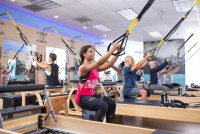
My journey in Pilates started in high school as an extracurricular activity. But it wasn’t until college that I discovered the benefits it had on me and enhanced my performance as a dancer.
Pilates is a series of Contrology exercises designed by Joseph Pilates in the 1920s. He designed it to help people address their overall health, posture, inefficient breathing patterns, and other stressors of modern society. Today, Pilates is used in various ways. For some, it’s a workout and way to keep fit, and for others, it’s a tool to rehabilitate an injury, surgery or aid postpartum moms.
Moving through these small, yet powerful exercises build a mind-body awareness. From noticing the hike in my hip while standing in-line at the store or the lean-to my left side while driving. These daily habits though small were wrecking long-term effects on my body.
For some, that might sound a little over-the-top to be analysing your everyday movements, but remember this, we were made to move. Our everyday postural habits matter the most and an awareness of what our body is doing helps us move efficiently and pain-free.
As our mind-body awareness increases, the more we can move freely. I’ve personally enjoyed Pilates because of the calm concentration it demands and how each movement flows from one to another. By the end of every session, I feel more awake, lengthened in my body and blood-pumped ready to start my day.
Here are three posture tips that will help you the next time you sign up for a Pilates class or are just standing in line at the supermarket checkout.
Pelvis
Most Pilates exercises reference “neutral pelvis”, this refers to the alignment of your hip points (the protruding bones on either side of your hips) with your pubic bone.
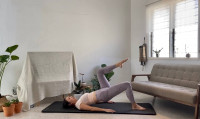
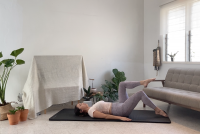
To find this position, lie back on the floor, knees bent and feet on the floor. Place the heels of your palms on the hip bones and line your thumbs together. Place your fingers down to form a triangle, with your pointer fingers resting on your pubic bone. Regardless of your body shape, if you’re in a neutral pelvis, your palms should be flat and parallel to the floor. If your fingertips are pointing diagonally upward to the ceiling, that’s a posterior tilt. If your fingertips are pointing diagonally downward to the floor, you’re in an anterior tilt.
It’s important to be in a neutral pelvis to be most efficient and maintain the natural alignment of the pelvis in any body position. It’s the way your body best moves functionally. When you’re standing, imagine that your pelvis is a bowl of water and that the water sits evenly and does not slosh out to the front or the back.
Ribs
When your pelvis is in neutral, it’s easier to align the rest of your body. Imagine your rib cage as an accordion: breath in and your rib cage expands laterally; breath out, your rib cage knits together, engaging your abdominal muscles.
Shoulders
Keep your shoulders stable but allow room for your shoulder blades to glide when arms are moving. If you feel tense or rigid in your neck and shoulders, take a deep breath and reset.
Head
To keep a natural curve in your neck, nod your chin downwards with roughly a tangerine-sized gap between chin and collarbone. Imagine the crown of your head lengthening upwards.
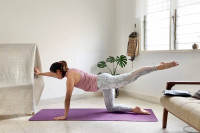
Alignment and posture are the key elements to make a workout effective. Try your best to move with deep breaths and avoid powering your way through Pilates with momentum.
Happy moving! – The Vibes, October 14, 2020