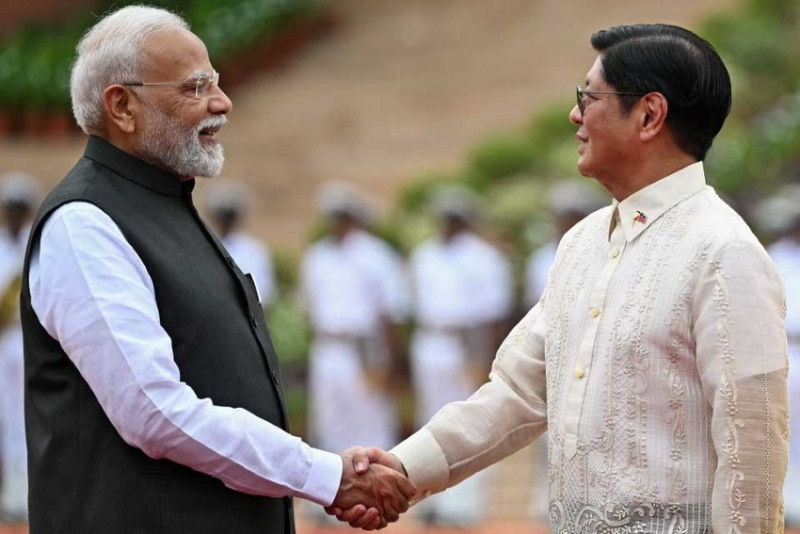
PHILIPPINES President Ferdinand Marcos Jr’s state visit to India this week has formalised a new strategic partnership between Manila and New Delhi, marking a shift in the Philippines’ foreign policy as it looks beyond traditional allies in the face of escalating tensions in the South China Sea and shifting global trade dynamics.
“Today, our relationship enters a new epoch,” The Straits Times cited Marcos saying at a joint media conference in New Delhi on 5 August, alongside Indian Prime Minister Narendra Modi. “India becomes only the fifth strategic partner of the Philippines.”
The announcement coincided with the first-ever joint maritime drills between the Indian and Philippine navies, held on 3 and 4 August within the Philippines’ exclusive economic zone in the South China Sea—waters also claimed by China. The timing and location of the exercises underscore the strategic dimension of the partnership amid Beijing’s increasingly assertive behaviour in the region.
Delivering rare public remarks in English, Modi said: “India and the Philippines are friends by choice and partners by destiny. From the Indian Ocean to the Pacific, we are united by shared values. Ours is not just a friendship of the past; it is a promise to the future.”
Shared Indo-Pacific vision
Defence analysts view the security cooperation as part of a broader recalibration in Philippine foreign policy. Marcos has been deepening ties with middle powers that share regional security concerns but are not entangled in the major power rivalry between the United States and China.
“The naval drills and state visit happening at the same time was no coincidence. It’s meant to project the mutuality of the interest of the two countries in the South China Sea,” said Dr Aries Arugay, visiting senior fellow at Singapore’s ISEAS – Yusof Ishak Institute. “India is also asserting itself as a major power not just in Asia, but globally.”
Security ties between the two countries have been building for some time. In 2022, the Philippines became the first foreign buyer of India’s BrahMos supersonic cruise missile in a US\$375 million deal, with the first batch delivered in 2024.
India has also publicly backed the Philippines’ legal position in the South China Sea. In 2023, in a rare move for an Asian country, India urged China to abide by the 2016 arbitral ruling by the Permanent Court of Arbitration in The Hague.
“India has become more sensitive to the security interests of its partners in South-east Asia, particularly the Philippines,” said geopolitical analyst Don McLain Gill of De La Salle University in Manila. “So this shows you also Manila’s willingness to incorporate India deeper into its security calculations.”
From India’s perspective, the Philippines has emerged as a significant strategic partner in ASEAN.
“The Philippines is important for India... because the Philippines has a distinctive maritime relevance in the region and it has taken on a definitive stand vis-a-vis China,” said retired Indian military officer C. Uday Bhaskar, director of the Society for Policy Studies.
He added that the Philippines’ purchase of the BrahMos system “gave credibility” to India’s growing ambitions as a defence exporter.
Beyond defence: trade and technology
The partnership is also set to expand beyond arms sales. Philippine officials have expressed interest in India’s Akash surface-to-air missile system, while discussions are under way for India to import Philippine nickel—a critical resource in defence manufacturing and steel production.
“India is also pursuing its own self-reliance efforts, and it seeks to present itself not just as a partner that sells arms, but also as a partner that builds capacities,” said Gill.
Secretary (East) of India’s Ministry of External Affairs, P. Kumaran, said both countries are exploring cooperation in submarine infrastructure, ship design and naval modernisation—areas that align with both nations’ aspirations for self-reliant defence postures.
India remains wary of China, particularly since the deadly 2020 border clash in Ladakh that froze bilateral relations. While diplomatic ties have improved marginally, trust remains elusive.
“If you notice, India and the Philippines represent different points in the Indo-Pacific region. From the perspective of geopolitics, it’s a big deal for the two nations to have a strategic security relationship,” said Arugay.
While defence was the central focus of the visit, economic diversification also featured prominently. Both countries have felt the consequences of protectionist policies under former US President Donald Trump. Philippine exports currently face a 19 per cent tariff, while India has been threatened with higher duties over its oil trade with Russia.
To that end, Manila and New Delhi are working towards a bilateral preferential trade agreement. Although Philippine-India trade exceeded US\$3.3 billion in 2024, it remains relatively modest.
Kumaran identified opportunities for collaboration in seaweed farming, biofuels, rice research, renewable energy, and oil and gas consultancy—particularly relevant given the Philippines’ high oil import costs.
Soft power agreements to deepen ties
Beyond defence and economics, the two leaders signed agreements in science and technology, digital innovation, outer space, mutual legal assistance, and cultural and tourism exchanges. Both sides also agreed to reciprocal visa-free entry for tourists, with direct flights between Manila and New Delhi expected to resume later this year.
“These soft-power agreements are ways to lock in the cooperation, so it will not just be at the level of pledges,” said Arugay. “These people-to-people, socio-cultural exchanges always have the value of complementing the defence and economic deals.”
The Philippines and India will also initiate regular maritime security dialogues, alternating between their capitals, following a model already in place with Australia and Japan.
Marcos’ visit is emblematic of a broader strategy of diplomatic hedging. With continued uncertainty over US tariffs and growing Chinese pressure in regional waters, the Philippines is preparing for a more fluid and less predictable global order.
“In the end, the Marcos administration has learnt from the past that it cannot overly rely on the US for all its security and defence needs,” said Arugay. “And it’s hard to get a hook on India. So this is a big achievement.” - August 6, 2025
.jpeg)