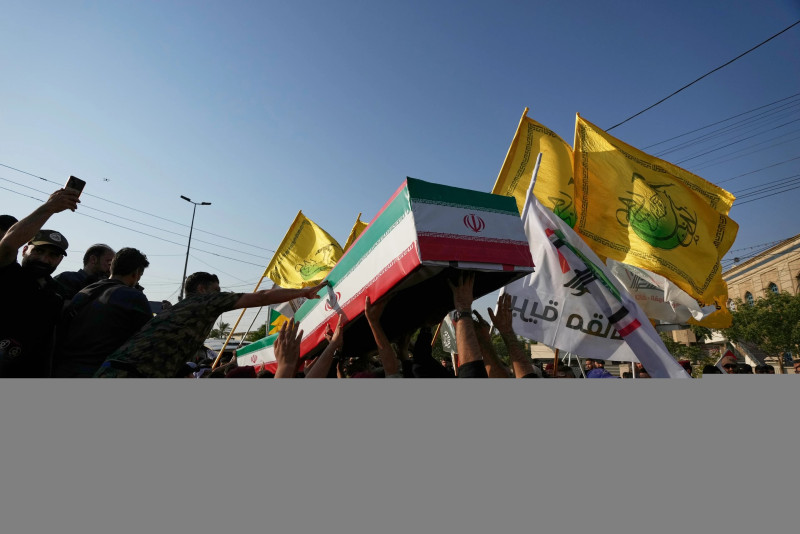
THE United States and Iran traded fresh missile strikes on Thursday as hopes for a swift end to their five-month conflict faded, with renewed hostilities raising concerns that the war could expand further across the Middle East.
The latest escalation followed several days of relative calm, but tensions intensified after both sides launched new barrages of attacks. Jordan said it had intercepted Iranian missiles for the second consecutive day, while Kuwait reported that a strike in the north of the country killed one person.
AP reported today that the conflict has also spread beyond direct US-Iran exchanges, with drone attacks causing fires on vessels at an Egyptian port and Saudi Arabia reporting attacks by Iran-backed militias in Iraq.
The prolonged war, which US President Donald Trump initially said could last four to five weeks, has contributed to rising fuel prices, disrupted global markets and increased concerns over military resources and weapons stockpiles needed by Washington to defend its bases and allies.
The conflict has also become increasingly unpopular among Americans, with a new AP-NORC poll showing Trump’s approval rating on Iran declining slightly from the previous month.
The latest fighting ended a temporary pause that had raised hopes among international mediators of progress towards diplomacy, including efforts to restore stability around the strategically important Strait of Hormuz.
Pakistan, which has played a key role in mediation efforts, warned that the security situation remained fragile.
“We note with concern that the security situation remains precarious,” said Pakistani Foreign Ministry spokesperson Tahir Andrabi.
“Talks are ongoing to normalize the situation, particularly the situation in the Strait of Hormuz,” he added.
US and Iran Trade Fresh Strikes
An Iranian missile strike hit a Chinese company’s building in Kuwait on Thursday, causing severe damage and killing one worker, according to Kuwait’s military.
The attack came hours after Jordan’s air defences intercepted five missiles launched from Iran. No injuries were reported from the interception, according to Jordan’s state-run Petra news agency.
The strikes followed a US military operation described by the US Central Command as a “heavy wave of strikes against Iran” in response to an earlier Iranian missile attack on a US base in Jordan.
US forces targeted dozens of locations linked to Iran’s Islamic Revolutionary Guard Corps, including military command centres, missile and drone facilities, as well as coastal surveillance and defence installations.
Iran’s official IRNA news agency reported that three people were killed and two others injured in a strike on Qeshm Island, located near the Strait of Hormuz, a vital maritime route for global energy shipments.
The latest exchange came after the United States and Saudi Arabia jointly targeted Iran-backed militias in Iraq on Wednesday, killing at least 20 fighters and six Iranian advisers, according to reports.
Drone Attacks Raise Concerns Over Regional Expansion
The conflict widened further after British maritime security firm Ambrey reported that drone strikes caused fires on two natural gas vessels at Egypt’s Damietta port.
The affected vessels included a US-owned floating storage facility and a Greek-owned tanker. No injuries were reported, and authorities have not confirmed responsibility for the attack.
Egyptian authorities said initial investigations indicated the fires were caused by a drone, with investigators recovering evidence to determine its origin.
A strike on Egypt, a close US ally and regional mediator, would represent a significant expansion of the conflict if Iranian involvement or that of its allies is confirmed. Yemen’s Iran-backed Houthi rebels have denied responsibility.
Iranian Foreign Minister Seyed Abbas Araghchi did not directly deny involvement but stressed Egypt’s importance as a regional partner.
“Egypt is an important friend and partner in the region, and its security is of utmost importance to us,” he said.
Global Economy Hit by Energy Disruptions
The war has severely affected global energy markets, with shipping through the Strait of Hormuz falling sharply amid repeated attacks and security concerns.
Around 20% of global oil and natural gas shipments pass through the strategic waterway during normal conditions, making its security central to efforts to resolve the conflict.
Shipping data from Lloyd’s List Intelligence showed traffic through the strait dropping from 82 vessels during the week of July 13-19 to just 39 between July 20-26.
Energy disruptions have also intensified elsewhere, with Saudi Arabia accusing Iraqi militias of launching drone attacks against its oil facilities.
The Iran-backed Houthi movement in Yemen has separately declared a blockade of Saudi shipping and threatened traffic through the Bab el-Mandeb Strait, another crucial trade route linking the Red Sea and the Gulf of Aden.
While some Saudi oil exports continue through the Bab el-Mandeb route, shipments have become more costly and complicated, with tankers diverting through alternative routes involving pipelines between Egypt’s Red Sea and Mediterranean ports.
Saudi Defence Minister Khalid bin Salman met Trump and Vice President JD Vance on Wednesday, with officials saying Riyadh’s participation in US strikes against Iraqi militias was intended to signal that Saudi Arabia would not tolerate attacks on its energy infrastructure.
However, Saudi officials also stressed their desire for de-escalation and a return to negotiations between Washington and Tehran. - July 31, 2026










.jpg)