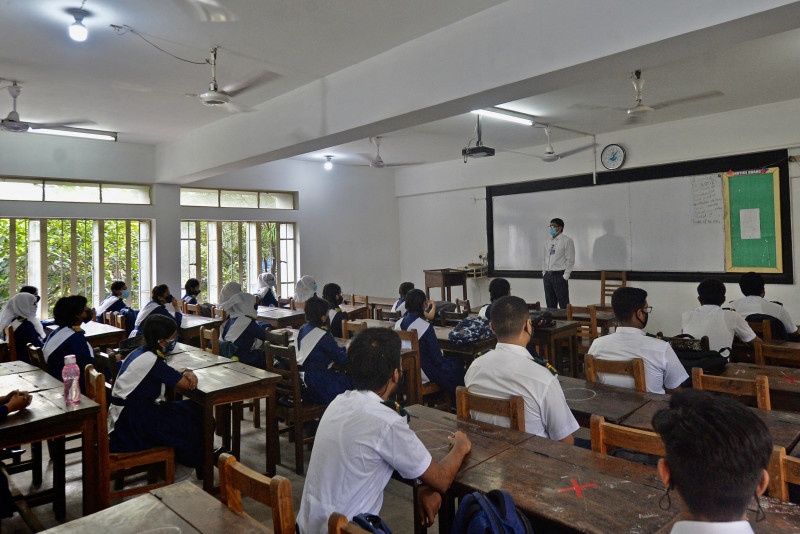
DHAKA – Children in Bangladesh flooded back into classrooms today as schools reopened after 18 months, one of the world’s longest coronavirus shutdowns.
The resumption came after Unicef warned that prolonged school closures during the Covid-19 crisis are worsening inequities for millions of children across South Asia.
Here, students at one school were welcomed with flowers and sweets and told to wear masks and sanitise their hands. Some hugged each other in excitement.
“We are really excited to be back at school,” 15-year-old Muntasir Ahmed told AFP as he entered the campus.
“I am hoping to physically see all of my friends and teachers, not through a laptop window today.”
At the gate, school officials checked the body temperatures of students before allowing them to enter.
The school’s vice-principal Dewan Tamziduzzaman said he “didn’t expect such a big number to be turning up on the first day”.
Only 41% of Bangladesh’s 169 million population have smartphones, according to the country’s telecommunications operators’ association, which means millions of children cannot access online classes.
Even with smartphones, students in many of Bangladesh’s rural districts do not have the high-speed internet access usually required for e-learning.
Enormous setbacks
In a report released on Thursday, Unicef warned that the pandemic has accentuated “alarming inequities” for more than 430 million children in the region.
“School closures in South Asia have forced hundreds of millions of children and their teachers to transition to remote learning in a region with low connectivity and device affordability,” Unicef regional director George Laryea-Adjei said in a statement.
“As a result, children have suffered enormous setbacks in their learning journey.”

In India, 80% of children aged 14 to 18 said they learnt less than when they were in a physical classroom, according to Unicef.
Among children aged between 6 and 13 years, 42% said they had no access to remote learning.
“Their future is at stake,” Deepu Singh, a farmer in India’s Jharkhand state, said last week of his children aged 9 and 10.
The pair have not been to school in a year and have no internet access at home, Singh told AFP, adding: “I do not know English. I cannot help him (my son), even if I want to.”
Students in the rest of the region are similarly impacted, Unicef reported.
In Pakistan, 23% of young children have no access to any device for remote learning.
Some towns in Nepal have been broadcasting radio lessons due to the lack of internet access.
“We are (in) a dangerous situation,” Nepalese schoolteacher Rajani K.C. told AFP last week.
“If the pandemic continues and the academic sector loses more years, what kind of human resources will the country have in the future?” – AFP, September 12, 2021