
KUALA LUMPUR – The death throes of the Perikatan Nasional (PN) government are getting worse than ever as its survival lingers on the whims and fancies of Umno lawmakers.
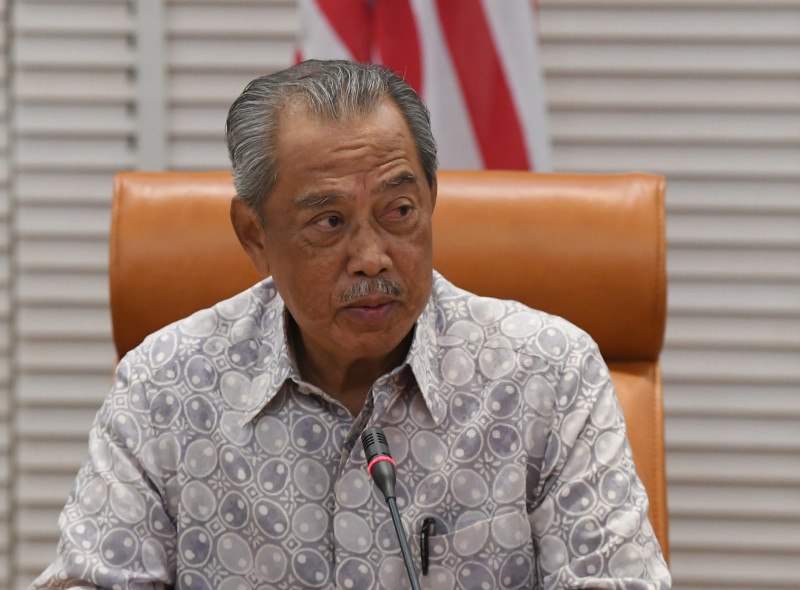
The potential national address by Prime Minister Tan Sri Muhyiddin Yassin this evening could be one of his last as the Bersatu president figures out salvaging the deep divisions sown between his former party Umno and its splinter, which he heads.
On the one hand, the Pagoh MP and his band of 30 MPs must figure out stratagems that will ensure Bersatu survives either before the government collapses or post the 15th general election (GE15).
While on the other hand, Muhyiddin must contend with numerous national issues such as the sudden surge of Covid-19 cases, which have surpassed the 3,000 daily cases mark; dealing with the devastating floods throughout the east coast; and solving the nation’s present struggles such as rising unemployment, economic downturn, and lack of foreign investment.
Despite the announcement by Umno Machang MP Datuk Ahmad Jazlan Yaakob to retract his support for PN, PAS’ Minister in the Prime Minister's Department (Parliament and Law) Datuk Takiyuddin Hassan insists that it does not affect PN’s majority in the Dewan Rakyat.
At present, the Malaysian parliament consists of 222 MPs of whom two passed on last year, leaving only 220 MPs in the lower house.
Supposedly, the PN government consists of Bersatu (31), PAS (18) and Sabah Star (1), while its allies Barisan Nasional consists of Umno (38), MCA (2) MIC (1) and Parti Bersatu Rakyat Sabah (1).
While Gabungan Parti Sarawak (GPS) comprising 18 MPs alongside the Lubok Antu MP, an independent, pledge their support for Muhyiddin, giving the 73-year-old a razor-thin lead with 112 MPs to form the government. The present composition of 220 MPs requires 111 MPs to form a simple majority government.
Pakatan Harapan’s (PH) composition of MPs include PKR (38), DAP (42), Amanah (11) with allegiances such as Warisan (8), Pejuang (4), Parti Sarawak Bersatu (2), United Progressive Kinabalu Organisation (1), Muda (1) and Simpang Renggam MP Maszlee Malik, also an independent aligned to the opposition, bringing the total to 108 MPs.
Based on the decision by Gua Musang MP Tan Sri Tengku Razaleigh Hamzah to abstain from voting during the recently passed budget and Ahmad Jazlan’s withdrawal of support, it can be safely assumed that the PN government has lost its majority in the Dewan Rakyat.
Flexing Bersatu’s muscle
Despite clarion calls by Bersatu’s leadership to forge on without Umno’s support, it is clear for Muhyiddin that he will not be able to continue his premiership under the PN banner for long despite the formalisation and appointment of Bersatu and PAS into state leadership recently.
Most importantly, the machinery for the newly established party is sorely lacking despite the added strength of former PKR deputy president Datuk Seri Mohamed Azmin Ali’s faction into the party.
Even a perfectly split support among Umno MPs for their former deputy president will not suffice for the present government to operate.
To sustain the present government, Muhyiddin would be left with several options. They are:
– Maintain Umno as its partner by giving in to more concessions such as the coveted deputy prime minister’s post and cabinet reshuffling, as well as acceding to Umno’s demands on seat allocations.
– Forging a renewed alliance with PH component parties such as PKR while extending the hand further to Datuk Seri Mohd Shafie Apdal'’s Warisan. Both PKR president Datuk Seri Anwar Ibrahim and Shafie are known to be close with the prime minister despite present political alignments following their years in Umno.
Despite having both options, chances remain slim for Muhyiddin unless he is able to “pull a rabbit out of a hat”.
Umno’s stumper
It is no secret that Umno, along with its Barisan Nasional (BN) partners, are the kingmakers in this scenario. Unhappy at playing second fiddle to its splinter party, scores of Umno MPs and the majority of its grassroots at present want out.
However, several Umno MPs, mostly those presently under Muhyiddin’s cabinet, continue to defend its part of the grand Malay-Muslim triumvirate alongside Bersatu and PAS.
The most vocal of those voices is the recently sacked BN secretary-general Tan Sri Annuar Musa, who has previously stated that Umno is no longer the strong party that it was and should not behave with a superiority complex.
Today, he is more or less treated as Bersatu’s stooge, with many Umno leaders calling for his ouster from the party. Others such as former Umno Youth chief Khairy Jamaluddin remain keen to continue with the present government on more reasonable grounds such as ensuring that the Covid-19 vaccination programme by the government runs smoothly without any disruptions.
Akin to a spoilt child, Umno’s options are aplenty. Party president Datuk Seri Ahmad Zahid Hamidi continues to toy with Anwar and PKR while still considering an affair with its arch-nemesis DAP. The recent Perak menteri besar crisis only goes to show that anything is possible in politics.
According to a PKR source, while several Umno leaders are willing to stump up Anwar as prime minister in an unprecedented alliance, their demands for “no DAP” have been met with swift resistance from the Port Dickson MP.
The source also said Anwar is keen to see that PH continues as a coalition with a “relationship of convenience and stability with Umno/BN”. This, the source said, is due to Anwar learning his lesson following the “strong, formidable, convincing” tango with Umno last year.
At the same time, Umno’s leadership is also keen to cash on its Muafakat Nasional (MN) partnership with PAS for GE15. This is despite the Islamic party’s dalliance with Bersatu in the PN coalition.
Will Umno experience another split over their differing agendas ? The party’s annual general assembly this month will be the litmus test on the strength of its leadership.
What is PAS’ decision?
The 18 PAS MPs must be in a dilemma. Which do they choose – Umno, with whom they held hands with for 22 months in the opposition into the present government, or Bersatu, who gave them the first taste of federal power and positions in decades?
Among the three Malay-Muslim parties, PAS is seen to be thriving most in the present government. The key to PN's stability may lie in their hands, but beyond that it would be best if they continue the alliance with Umno simply to improve chances of retaining their traditional states better.
An allegiance with Bersatu may not necessarily translate to victory due to the poor machinery factor as mentioned earlier.
That said, taking numerous factors into account, the days of the PN government and Bersatu could be truly numbered even before the dissolution of Parliament and confirmation of polling day.
Even so, Umno leaders are not on the same page when it comes to holding a general election in the midst of a worsening pandemic.
Vice-president Datuk Seri Mahdzir Khalid voiced his concern for holding an election, but secretary-general Datuk Seri Ahmad Maslan effectively said: “If you can queue for food, you can queue to vote.”
Whatever these next few days bring, one thing for sure is that this country has never been so politically polarised.
The nation’s survival depends on our politicians getting their ducks in a row. – The Vibes, January 11, 2021