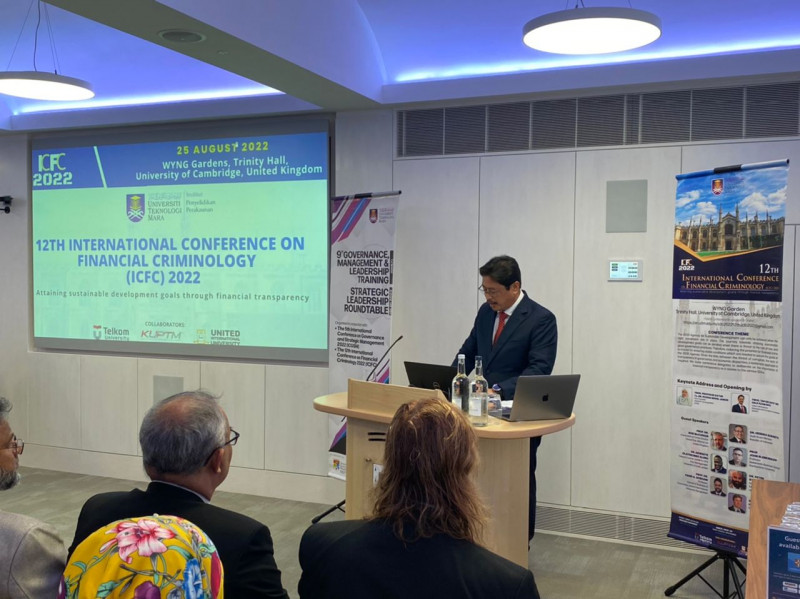
KUALA LUMPUR – The Malaysian Anti-Corruption Commission (MACC) faces formidable challenges in investigating high-profile graft cases in the country despite undertaking rigorous efforts toward putting suspects on trial, its chief commissioner said recently.
Speaking at a conference on financial crimes held at Cambridge University in the UK, Tan Sri Azam Baki asserted that the agency will nevertheless soldier on as a number of the cases are still ongoing.
In particular, he pointed to one particular case where the hard work bore fruit with conviction and recovery of national assets.
He said that MACC faced many challenges in ensuring that culprits were brought to justice.
However, the combination of effective intelligence is key to a successful investigation, he stressed.
For example, he added that there are several high-profile cases that are still on trial as well as a recent one that has received the court’s verdict, he added.
“This comes after a long struggle for the MACC – our hard work to investigate this complex case, to recover our nation’s assets and to help in the successful prosecution has come to fruition, and still the work continues,” he said.
On August 23, the Federal Court upheld the decision that former prime minister Datuk Seri Najib Razak is guilty of all seven charges in the SRC International Sdn Bhd corruption case.
Najib was ordered to serve his 12-year jail sentence beginning that very day.
Azam was delivering his keynote address at the International Conference on Financial Criminology with the theme “Attaining sustainable development goals through financial transparency”.
The conference was co-organised by Universiti Teknologi Mara, United International University, Telkom University, and hosted by Cambridge University.
Also present were MACC deputy chief commissioner (operations) Datuk Seri Ahmad Khusairi, director of the agency’s special operations division Datuk Tan Kang Sai, director of anti-money laundering division Mohamad Zamri Zainul Abidin, and director of financial analysis division Mohd Azwan Ramli.
Guest speakers were Rob McCusker, director for transnational crime at Global Risk Alliance Ltd, UK, and Hendra Susanto, Indonesia’s audit board member.
Azam also said that transparency needs to be embedded thoroughly in all the procurement processes, from budget allocation, assessment of needs, bidding and open-tendering of contracts, implementation of the contracts and auditing processes.
“The shady activities between the private sector and corrupt public officials are able to thrive in a condition of heavy bureaucracy and the lack of transparency in government procurement processes,” he said.
He said that financial crimes remain pervasive and are contributing to the ongoing illegal activity relating to the environment, as well as leakages in government procurement for the country’s development.
“Financial crimes and corruption pose threats to national security, equitable economic development, environmental sustainability, promotion of renewable energy, action against climate change and the sustainable goals to end hunger and poverty,” he added. – The Vibes, September 1, 2022











.jpeg)


.jpg)