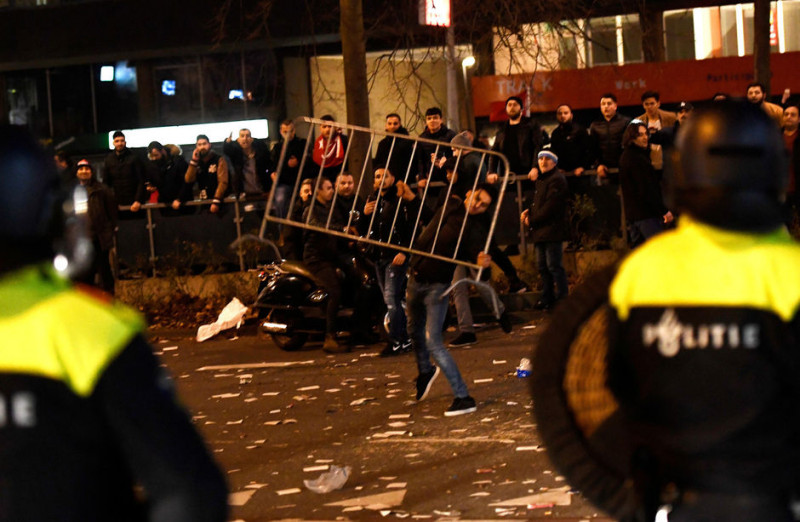
THE HAGUE – The Netherlands has been hit by a second night of riots, as coronavirus curfew frustrations boiled over, even as President Joe Biden said herd immunity could be achieved this year.
With global infections fast approaching 100 million, any chance such community-wide protection is heavily dependent on the roll-out of inoculations.
But wrangles over distribution have emerged in recent days, with the European Union criticising a delay in AstraZeneca’s delivery of its shots, and Russia and China offering to step into the breach for less wealthy countries with their home-grown jabs.
Netherlands Prime Minister Mark Rutte told reporters the weekend’s street violence was “unacceptable. All normal people will regard this with horror”.
Yesterday night, protesters rampaged again in several cities following the introduction of a coronavirus curfew over the weekend.
Riot police clashed with groups of protesters in Amsterdam and elsewhere, including the port city of Rotterdam, where people smashed shop windows, and police deployed a water cannon.
There was unrest too in Israel, where a bus was torched in one of many protests against virus restrictions in ultra-Orthodox districts, including Bnei Brak near Tel Aviv, and Mea Shearim in Jerusalem.
And in Australia, thousands defied coronavirus rules today to protest the country’s national day, held on the anniversary of British colonisation that its indigenous population brands “Invasion Day”.
Officially recognised as Australia Day, January 26 sees annual rallies drawing attention to the injustices faced by Indigenous people.
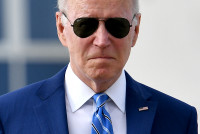
Away from anger on the streets, a note of optimism came from Biden, who said mass vaccinations would become available within months.
“I feel confident that by summer we’re going to be well on our way to heading toward herd immunity,” the leader of the world’s hardest-hit country said.
But further challenges could be on the way for the new president, after health authorities in Minnesota confirmed the first US case of a Brazilian variant.
Europe was dealing with a blow to its vaccination campaign, after British-Swedish drugs company AstraZeneca warned it would not be able to meet promised targets on EU shipments – a week after US group Pfizer said it was also cutting delivery volumes.
European health commissioner Stella Kyriakides slammed the delay as unacceptable, vowing the body would “take any action required to protect its citizens and rights”.
Orders for Russia’s Sputnik V shot were gaining pace, with Mexico – where the coronavirus death toll has passed 150,000 – agreeing yesterday to buy 24 million doses.
Developers claim the jab is more than 90% effective, although the vaccine was registered before large-scale clinical trials and has yet to be approved by Mexico’s health regulator.
And Ukraine – which could use jabs provided by UN scheme Covax, as well as China’s CoronaVac – announced it would “soon” obtain a million doses to kick off a vaccination campaign. – AFP, January 26, 2021