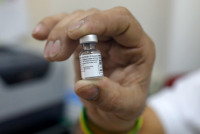
THE HAGUE – The European Union’s medicines regulator today said blood clots should be listed as a rare side effect of the AstraZeneca Covid-19 vaccine, but the benefits continue to outweigh risks, as several countries battle fresh virus surges amid shot shortfalls.
A number of nations have suspended the use of the AstraZeneca vaccine for the younger population after it was earlier banned in several places over blood clot scares.
The United Kingdom today said people under the age of 30 should choose alternatives to the shot, after reporting 19 deaths from clots among people who received it.
The back-and-forth over the vaccine comes as countries from Germany to India face new waves of infections and deaths from the virus, which has now killed more than 2.8 million people globally.
Governments are scrambling to secure much-needed doses, with Australia being the latest nation to complain of shortages, which it blames on EU export controls.
The European Medicines Agency (EMA) today said blood clots should be listed as a “very rare” side effect, encouraging countries to continue the use of the AstraZeneca vaccine.
The announcement came after its safety committee examined reports of blood clots, but EMA chief Emer Cooke said no particular risk factor has been identified, adding that the clots could be linked to an immune response to the vaccine.
“Specific risk factors – such as age, gender or medical history – have not been able to be confirmed, as the rare events are seen in all ages.
“The benefits of the AstraZeneca jab in preventing Covid-19 overall outweigh the risk of side effects.
“It is saving lives.”

“Critical situation”
Canada, France, Germany and the Netherlands are among several countries that are not recommending the shot for younger people.
Britain urged under-30s to use other vaccines besides AstraZeneca, after reporting 79 blood clots and 19 deaths among the 20 million doses administered.
It did not, however, say how many people have been given the jab.
AstraZeneca’s vaccine has been administered in at least 111 countries, more than any of its rivals, according to data.
It is being used in wealthier countries and poor nations, largely as part of the World Health Organisation-backed Covax facility to ensure equitable access to vaccines.
The controversy surrounding the shot has marred a global roll-out that governments hope will help countries emerge from a pandemic that has ravaged the global economy and subjected much of humanity to some form of confinement.
In Germany, Chancellor Angela Merkel expressed support for a snap lockdown to stem rising cases, after decentralised measures failed to quell outbreaks.
Hard-hit France imposed tighter measures this week, while Ukraine today reported record new deaths and hospitalisations after tightening measures in the capital.
“It is no exaggeration to describe the situation as critical,” said Kiev mayor Vitali Klitschko, warning that the city’s hospitals will run out of beds “very soon”.
India, which registered a 24-hour record of almost 116,000 fresh infections today, said it, too, will roll out tougher curbs, with new curfews in place in 20 cities, including the capital New Delhi.

“Very stressed”
As millions readied for new anti-virus rules in India, the country’s Serum Institute – the world’s largest Covid-19 vaccine maker – said it needs financial aid, after the government imposed export restrictions to secure much-needed doses at home.
Production capacity at the institute – which makes the AstraZeneca jab – is now “very stressed, to put it quite frankly”, said CEO Adar Poonawalla.
Australia is facing woes of its own, after a mere 700,000 of a contracted 3.8 million doses of the AstraZeneca vaccine were delivered.
Prime Minister Scott Morrison has blamed EU for the shortages, accusing the bloc of “strict export controls”.
“It’s not a dispute. It’s not a conflict. It’s not an argument. It’s not a clash. It’s just a simple fact.”
More than 692 million doses of coronavirus vaccines have been administered globally, according to a tally, with just a handful of countries leading the pack by a wide margin. – AFP, April 7, 2021