
KUALA LUMPUR – The conflicting conclusions by the Johor Baru magistrates’ court and high court in the “basikal lajak” trial of 27-year-old clerk Sam Ke Ting have fuelled fierce public discourse over her “reckless driving” and the eight teenage victims.
In the high court’s grounds of judgment sighted by The Vibes, judge Datuk Abu Bakar Katar found that the trial court erred in its judgment when it accepted Sam’s explanation that she was not aware of “basikal lajak” activities in Jalan Lingkaran Dalam, Johor Baru.
Based on the grounds, amongst the “errors” in the magistrate’s findings was the possibility of another vehicle being involved in the fatal collision in 2017.
The respondent (Sam) should drive her car carefully and not speed until it can cause the accident. She should realise the accident site was not well lit at 3.20am and the range of view was limited.
“Thus, she should have been aware of the risk for driving her vehicle exceeding 50km/h,” the judgment read.
Abu Bakar also considered other factors before meting out his sentence such as “public interest that exceeds the respondent’s interest”.
The high court judgment pointed out that Sam was lucky that the incident occurred in 2017 before amendments were made in 2020 to the Road Transport Act, which would have resulted in a heavier sentence.
“The court also considers the offence committed by Sam as rampant in Johor. Statistics showed that between 2011 and 2021, there were 10,297 fatal accidents.”

Prosecution couldn’t prove Sam was the driver: lower court
Sam has been twice acquitted by the magistrates’ court. The first acquittal was in 2019, when magistrate Siti Hajar Ali decided that the prosecution had failed to establish a prima facie case.
Only upon an appeal by the prosecution to the high court was the case remitted back to the magistrates’ court where, after a full trial, Sam was again acquitted last October.
Following the grounds of judgment for Sam’s first acquittal, Siti Hajar said the prosecution requires three elements in order to establish a prima facie case:
- She drove the vehicle involved in the collision;
- She drove in a manner that was dangerous to other road users; and
- The accident caused death(s).
However, the lower court found that the prosecution failed to establish the first element, adding that there were reasonable doubts in the evidence presented.
As suggested by Siti Hajar, the only piece of evidence available pointing to Sam being the driver was a police report she filed after the incident.
According to eyewitnesses present during the time of the collision, the 13 individuals who gave evidence could not testify as to the identity of the driver.
One witness testified to seeing one Chinese man and woman near the vehicle when it was being moved and this was corroborated by a police officer.
But another witness said that he did not see a Chinese woman near the vehicle and there were only Malays in the area when the car was being moved.
Only danger on road was cyclists themselves
The magistrates’ court also found that Sam did not drive her car in a dangerous manner, as there was a lack of evidence to show she was speeding, intoxicated, or involved in other illegal acts.
Usually, before delivering judgment in cases pertaining to accidents, the court would consider evidence obtained after the incident such as the location of the deceased.
However, Siti Hajar said witnesses were not able to testify whether the recorded positions of the victims were their original positions after the crash or if they had been moved.
A police officer went on record in court over “basikal lajak” activities and explained the modus operandi of these cyclists.
The magistrates’ court was told that the police were aware of these late-night “basikal lajak” activities due to public complaints.
At the site of the accident, “basikal lajak” cyclists tend to push their bicycles uphill and ride downhill in the “Superman” position, sometimes taking up all three lanes along the highway, police investigations found.
Also based on evidence obtained from the bicycles of two victims, damage was found at the front wheels, leading the magistrate to conclude that they were cycling against the flow of traffic and that the collision was head-on.
“The court concluded that the dangers were caused by the victims themselves and the ‘basikal lajak’ gang at the location.
“The driver, who was driving uphill using a lawful lane, could not expect the presence of cyclists who were on the other side of the gradient at 3am.
“It is clear that the victims and their friends created a dangerous situation for other road users including the driver,” the magistrate’s judgment read.
Sam drove below speed limit of 50km/h
It was established during the trial that Sam was driving uphill and was not able to see the “basikal lajak” cyclists, and the prosecution could not definitively establish how fast she was driving and where the point of impact was.
Malaysian Institute of Road Safety Research (Miros) had suggested there were two possible points of impact based on the location of one of the victims’ bodies.
“It is clear from the evidence that there is no clear proof of where the point of impact occurred during the incident,” the magistrate’s judgment read.
With regards to the speed of the car, Miros submitted that the vehicle was possibly travelling at either 44.53 km/h or 74.86 km/h.
Because there were two inferences, the law required that the court choose the one that is favourable to the accused.
“Based on the speed of the vehicle during the accident below the 50km/h speed limit, the court finds that there was no wrongdoing of driving the vehicle over the speed limit,” the court said.
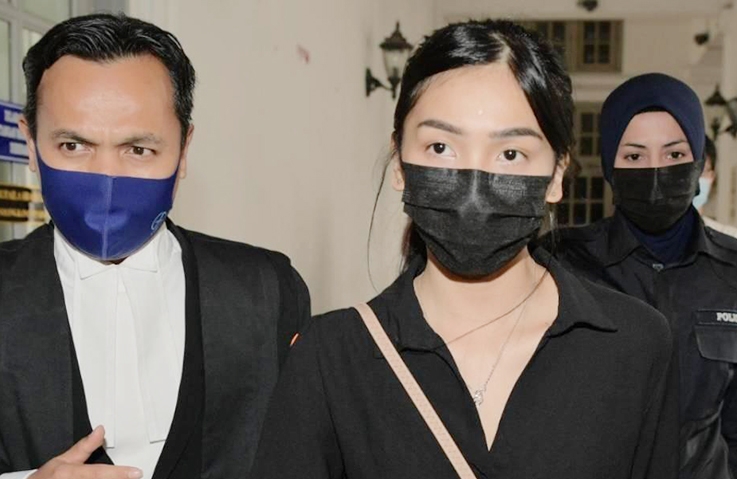
Sam was initially charged under Section 41(1) of the Road Transport Act 1987 for causing the death of eight “basikal lajak” cyclists by driving her vehicle dangerously or recklessly.
Despite her acquittal, the high court sentenced her to six years imprisonment and a RM6,000 fine, as well as a three-year suspension of her driver’s licence.
She was ordered to serve her sentence immediately upon conviction on April 13.
Although Sam intended to appeal against her conviction, the court did not grant her bail as she first requires leave to appeal from the Court of Appeal.
On Friday, her lawyer Muhammad Faizal Mokhtar said Sam had filed an appeal against the high court’s decision. – The Vibes, April 17, 2022